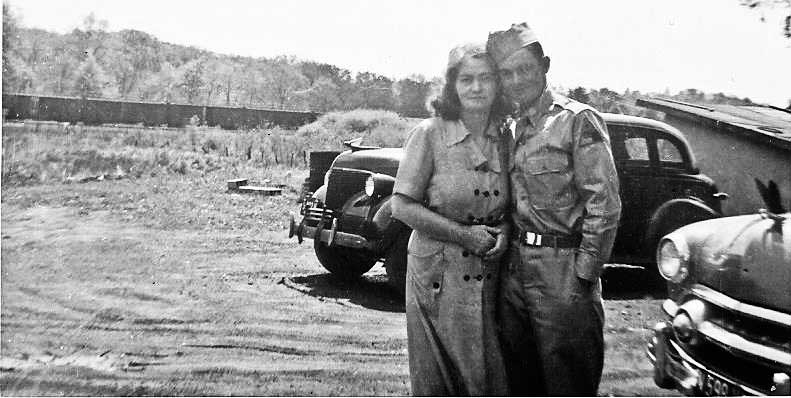
#TBT – Throwback Thursday

It's all relative…
I don’t know how many of you faced the same situation as I did when you read about the optional theme for Amy Johnson Crow’s 52 Ancestors 52 Weeks Challenge for this week, but I have had Carole King’s So Far Away stuck in my head since the first reading of the February themes. The Tapestry album takes me back to the time of junior high school (and, yeah, that was so far away also!). This was the first album that I owned that I memorized every lyric and every note of the piano. Remember how disappointed you would be when you bought an album because you liked a song from the radio, and then found that you didn’t really care for the rest of the album? For me, at least, that wasn’t the case with this one. I LOVED. Every. Single. Song. I usually either listen to NPR on the radio or play some music while I’m writing; and because the dogs were tired of hearing me sing, I chose Carole King’s Tapestry as my soundtrack for today. How fitting then, that today is the 44th anniversary of the release of that album?
This year I wanted to make it a priority to track down more information on my direct maternal line. Because finances were an issue, I opted to have the autosomal DNA test done instead of the mtDNA test. I may have found more answers to the maternal direct line with the other route, but after discussing with others – perhaps not. I tested with Ancestry originally and when doing a search for the surname Withrow within the trees, I find I have many matches within locked trees and, alas, so far no responses.
As it turns out, I am spinning my wheels at my 5th great-grandmother, Elizabeth, wife of David Withrow. What I do know about Elizabeth are a bunch of probably and maybes. She was probably born around 1782 and maybe in Pennsylvania. She probably died somewhere around 1830 in Columbiana (now Carroll) County, Ohio. She probably married David Withrow around 1795, maybe in Beaver County, Pennsylvania. David was probably born between 1765 and 1771 in Pennsylvania. Precious little is known about him also. I know that there were was a Withrow that came over from Scotland in the early eighteenth century, but so far I haven’t been able to connect to that line.
This past week I have centered my researching on Beaver County, Pennsylvania and, once again, in East Township, Carroll County. At some point, I imagine that I just might become an expert on these two areas! We find David Withrow in South Beaver Township, Beaver County, Pennsylvania in 1804 where he has signed a petition asking for the township to be split because it is too large to easily attend township meetings or to work on the public roads without travelling a far distance.

We also find two other familiar people that have added their names to the petition, Charles Phillis and Jacob Hackathorn. Charles Phillis was the father of Catherine Phillis, mother-in-law of Mary Amna Myers. Jacob Hackathorn, who signed, was the father of Christian Hackathorn and son of Reinhard Jacob Hackathorn. It is quite apparent that these ancestors of mine rendezvoused in Beaver County, Pennsylvania at the edge of the frontier and hopped on land in Ohio as soon as it was relatively safe to do so and as the land started to open up to settlement. And, it seems, they beat feet to the area around what is now East Township, Carroll County.
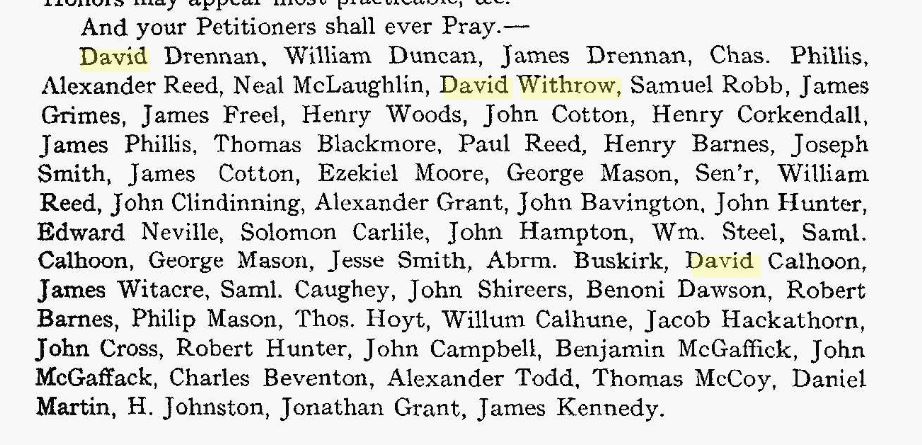
In my search for Elizabeth, I have been forced to concentrate on finding where her husband, David Withrow was. We see that he is still in Beaver County, Pennsylvania during the 1810 census.

David Withrow also fought in the War of 1812 in Findlay’s Battalion of Pennsylvania Volunteers, so we have to assume that they were still in Pennsylvania at that time.
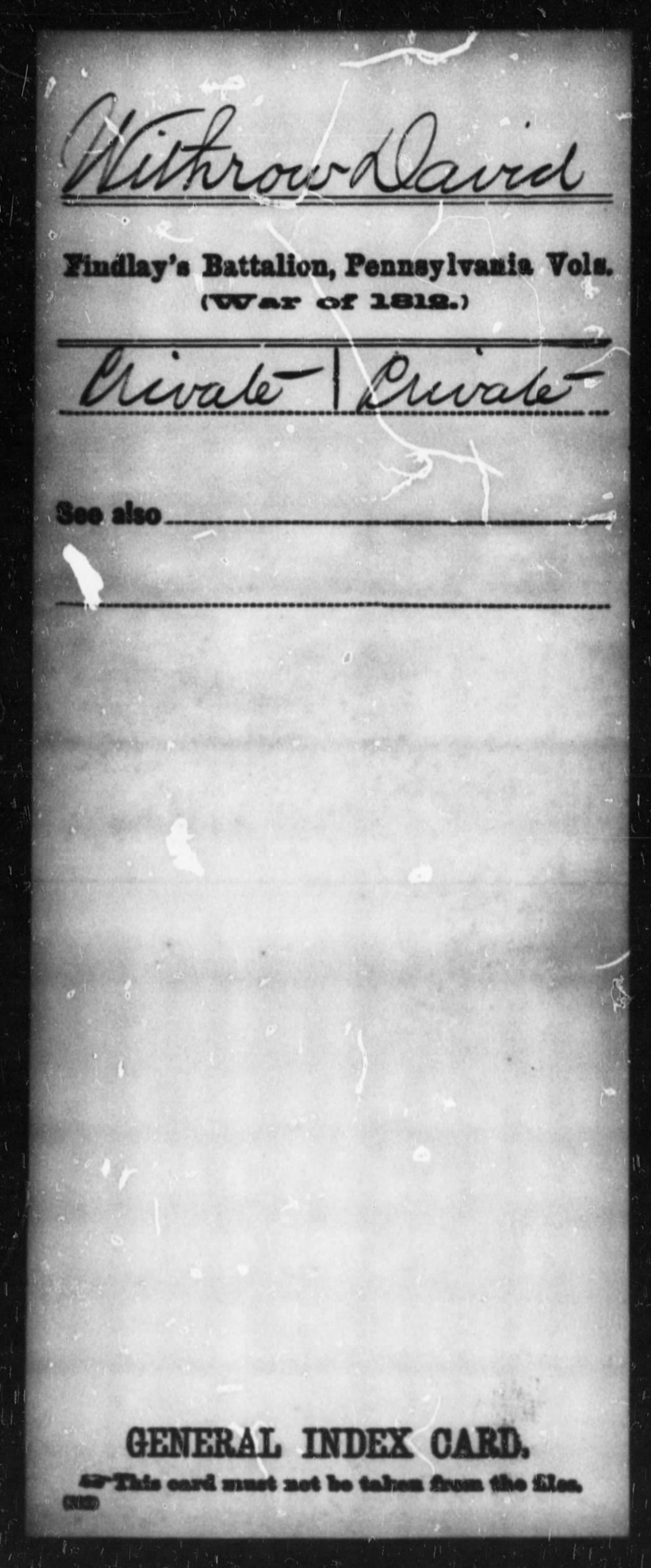
And although I haven’t found David and family in the 1820 census as of yet, we do find him in an 1821 tax record in Columbiana County, Ohio (now Carroll).

Here we see the land patent (along with two others entered into with a Hardgrove, not pictured) and a land plat, although it appears from the dates that he was living in this area before he owned the land.
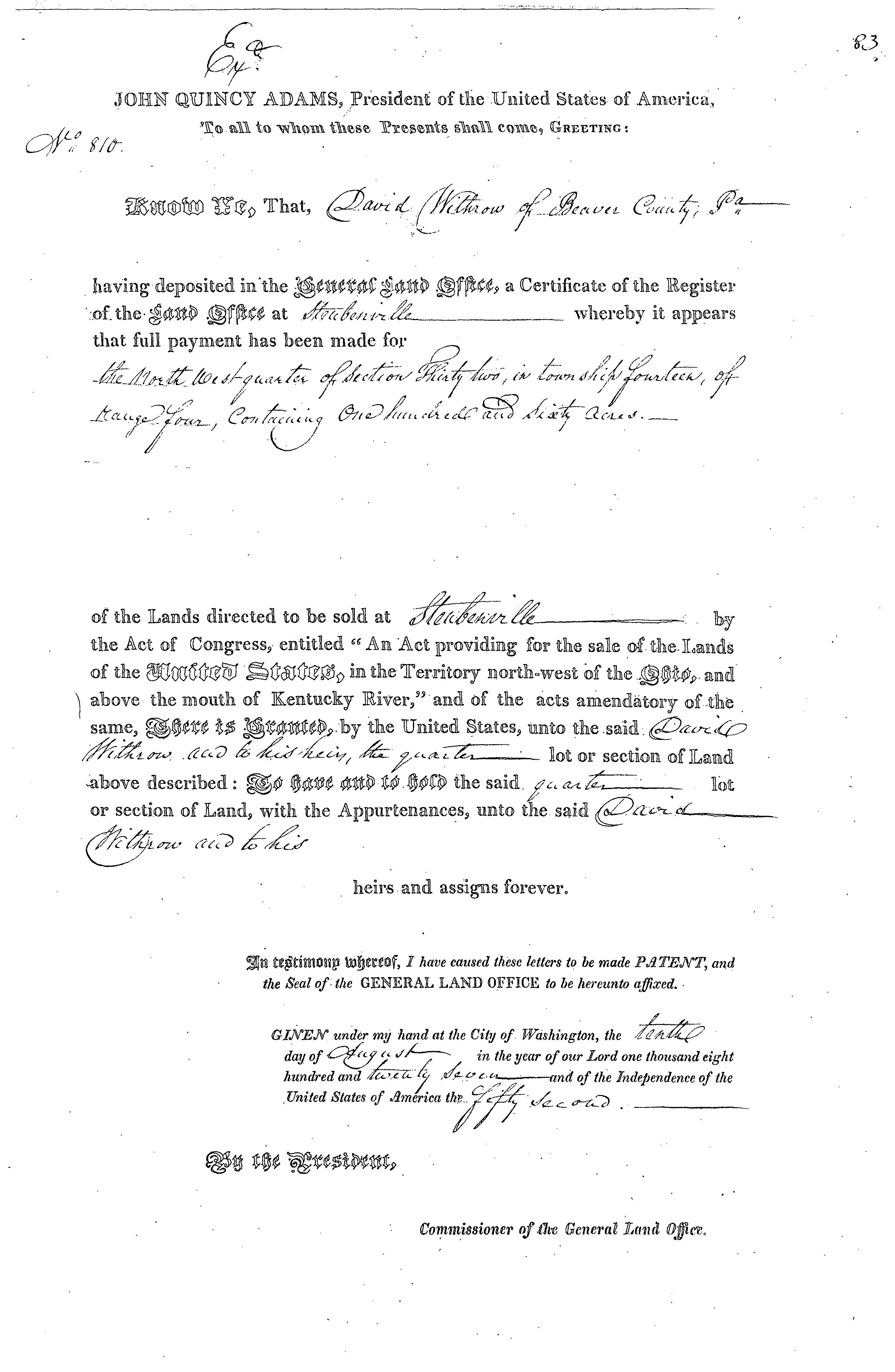
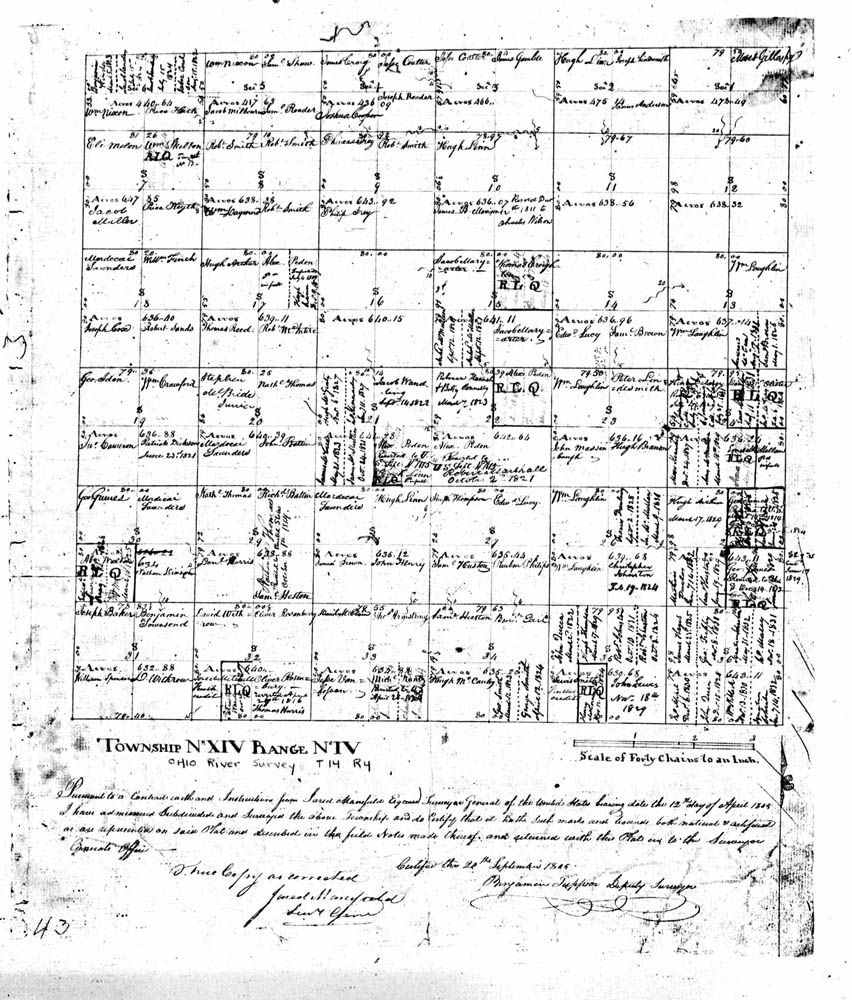
While looking at the household members in the 1830 and 1840 censuses, it appears from the ages of those listed that Elizabeth passes away some time between those censuses. I have yet to locate the graves of David or Elizabeth, but there are Withrows at Glade Run and Mechanicstown (in nearby Fox Township) cemeteries. Following are family group sheets detailing the children of David and Elizabeth Withrow:
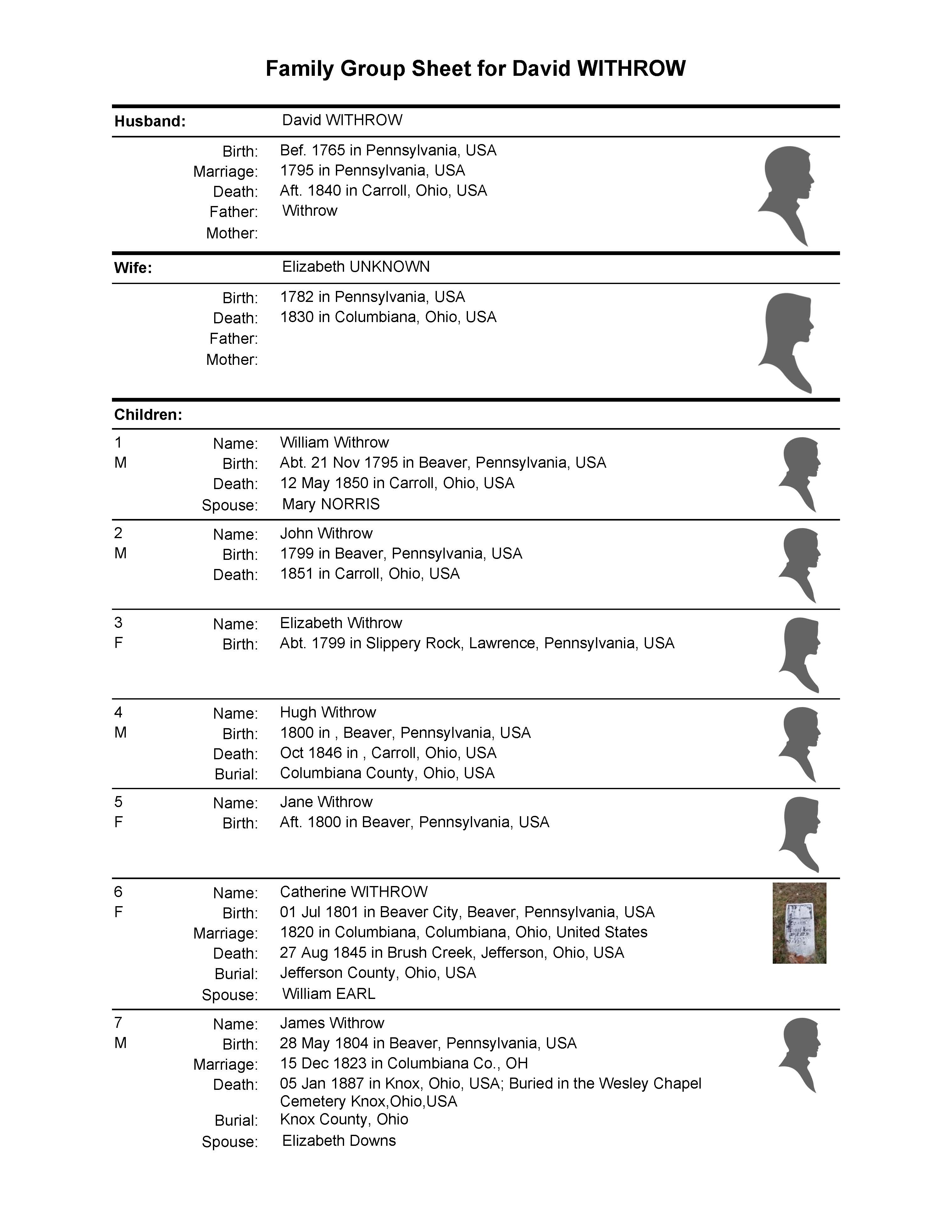
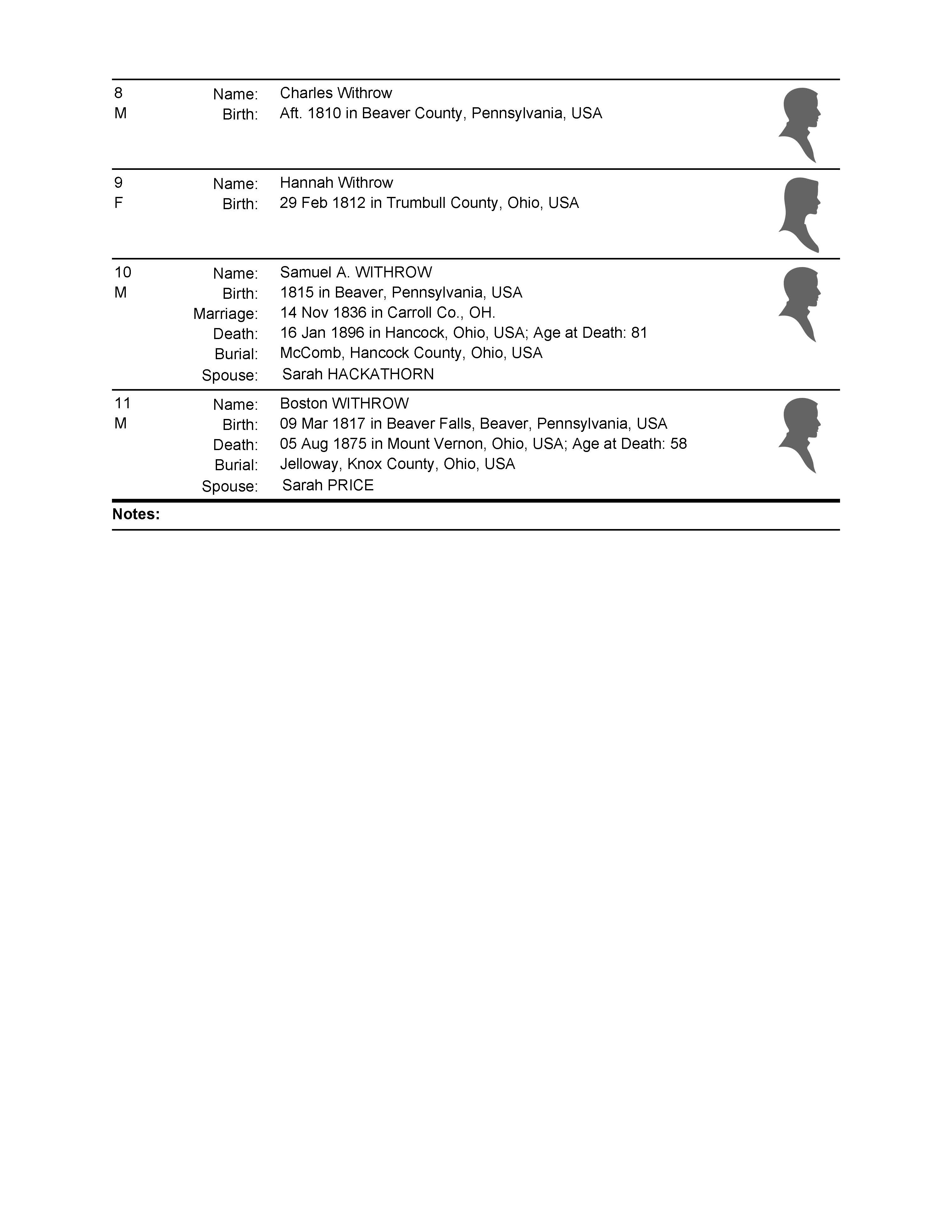
I methodically started researching each of these children in a search for clues about Elizabeth and was quite happy to find something in a book about Knox County, where son, James had moved to with his family because this answered the question of when David and Elizabeth had relocated and also proved to me that David’s wife was, indeed, named Elizabeth.
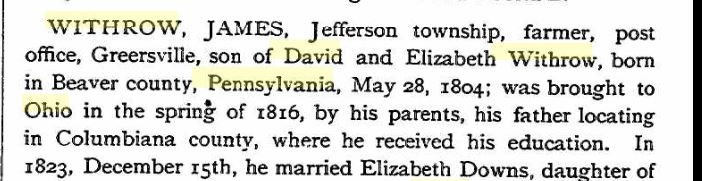
At this rate, I don’t know if I’ll ever be able to trace my direct maternal line back to one of the “Seven Daughters of Eve”. In the meantime, I’ll keep searching for Elizabeth and her family. If you see her, let me know. I feel as if I’m so close to finding her, but yet…so far away.
Sources:
Hill, N. N., and A. A. Graham. History of Knox County, Ohio, Its past and Present, Containing a Condensed, Comprehensive History of Ohio, including an Outline History of the Northwest; a Complete History of Knox County … a Record of Its Soldiers in the Late War; Portraits of Its Early Settlers and Prominent Men … Biographies and Histories of Pioneer Families, Etc. Mt. Vernon, O.: A.A. Graham, 1881. 838-39. Print.
Bausman, Joseph H., and John Samuel Duss. History of Beaver County, Pennsylvania: And Its Centennial Celebration. New York: Knickerbocker, 1904. Print.
Ancestry.com, 1810 United States Federal Census (Provo, UT, USA, Ancestry.com Operations, Inc., 2010), http://www.ancestry.com, Year: 1810; Census Place: Ohio, Beaver, Pennsylvania; Roll: 45; Page: 458; Image: 00031; Family History Library Film: 0193671. Record for David Withrow. http://search.ancestry.com/cgi-bin/sse.dll?db=1810usfedcenancestry&h=412141&indiv=try.

Elsie Marcella Hackathorn taken in Bergholz, Ohio probably circa 1916.
Today is NOT my birthday, but the optional theme for Amy Johnson Crow’s 52 Ancestors 52 Weeks Challenge, is “closest to your birthday”. I share my birthday with Reinhard Jacob HECKENDORN, my 5th great-grandfather. Not the same year, mind you. We were born 300 years apart from each other.
A large part of the joy of looking into my family history has always been the detective work involved in the search for the facts involving each individual. It has always been important to me to see that each person was, indeed, an individual. Figuring out their own life story that happens in between the facts is a guessing game, at best. Being a big fan of history, I am forever being side-tracked by the history of the area and time period that my ancestors lived in. Realizing that not everyone cares to have a history lesson, you will find that I have embedded links to more information in my blog posts so that those who are so inclined can read more about certain subjects. That being said, I am always eternally grateful for those researchers who have come before me and have meticulously gathered the proof on my family lines. The incredible amount of dedication of their time, and money, and generosity of sharing those findings is invaluable to me. I, personally, would be nowhere near where I am now in my knowledge of the Hackathorn line without the efforts of Hollis A. Hackathorn, Jim Bollinger, Ann C. Sherwin, and Theodore A. Heckathorn. Before I start the story of Reinhard Jacob HECKENDORN, I would like to thank these people for their investigative work.
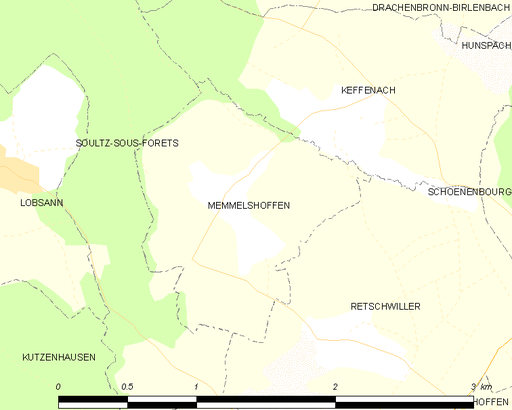
Reinhard Jacob HECKENDORN was born 06 June 1715 in Memmelshoffen to Hans Martin HECKENDORN and Anna Maria (surname unknown).
Meimelshoffen
17.
Den 6t Juny 1715 wurde Hanß Martin Heckendorn
Bürger undt Einwohner zu Meimelshoffen undt
Anna Maria seiner ehelichen Haußfrau ein
iunges Söhnlein gebohren, welches den 9ten ej. zur
heiligen Tauff gebracht undt mit dem Nahmen
Reinhard Jacob genennet worden ist. Gevatter-
leuth waren der S.T. hiesger Saltzherr
Reinhard Jacob Krug von Nidda. it. Philipps
Sauerkopff Becker undt Wirth zum Schwanen
allhier. it. Anna Maria Abraham Jelitzers
…
Memmelshoffen
17.
A young son was born on the 6th of June 1715 to Hanss Martin Heckendorn, burgher and resident of Memmelshoffen, and Anna Maria, his wife, and was brought for holy baptism on the 9th of the same month and named Reinhard Jacob. Godparents were the local salt man salvo titulo* Reinhard Jacob Krug of Nidda; Philipps Sauerkopff, baker and proprietor of the inn Zum Schwan here; Anna Maria, … of Abraham Jelitzer… [bottom line worn away].
*Note: This Latin term, abbreviated S.T. in the source text, indicates that the man has a more formal title not given here. ACS
“Original record transcribed and translated by Ann C. Sherwin: http://asherwin.com”.
Reinhard Jacob’s grandfather, Jacob HECKENDORN, had been born in Langenbruck, Switzerland in 1646 and had moved to the Bas-Rhin region, about 100 miles north, sometime before Hans Martin was born in Memmelshoffen in 1682. The Bas-Rhin region has had a volatile history with the borders changing many times throughout history. Today this area is part of France with many people who speak French with a German accent. It would be interesting to know the languages spoken in the Heckendorn household in 1750. It is probable that the main language was Germanic.
![1749 Map of France By Claude Buffier (andrea marchisio) [Public domain], via Wikimedia Commons](https://relativityitsallrelative.com/wp-content/uploads/2015/01/map_of_france_wellcome_v0049915.jpg)
Reinhard Jacob married Margaretha CULMANN of Retschweiler on 03 September 1737 and a son, Phillip, was born to them 03 March 1738 in Retschweiler. Margaretha died sometime around 1740 and Phillip did not accompany Reinhard to America, so we do not know his fate. The widowed Reinhard then married Anna Barbara JUNG, the daughter of Theobald JUNG and Mary Catherina on 18 April 1741.
While living in Retschweiler, Reinhard (known as Jacob) and Anna Barbara were raising three children – Maria Magdalena, born 26 November 1741; Johann Jacob, born 22 July 1744; and Maria Barbara, born 20 October 1746. In many documents, Jacob was simply listed as a burgher. Definitions of burgher point to one who is an inhabitant of a town, especially of the middle class. By the time his daughter, Maria Barbara, was born in October of 1746, Jacob is described as having the occupation of a sludge-box tender in the saltworks. By the summer of 1750, Jacob and family would be packing up and setting sail for America.
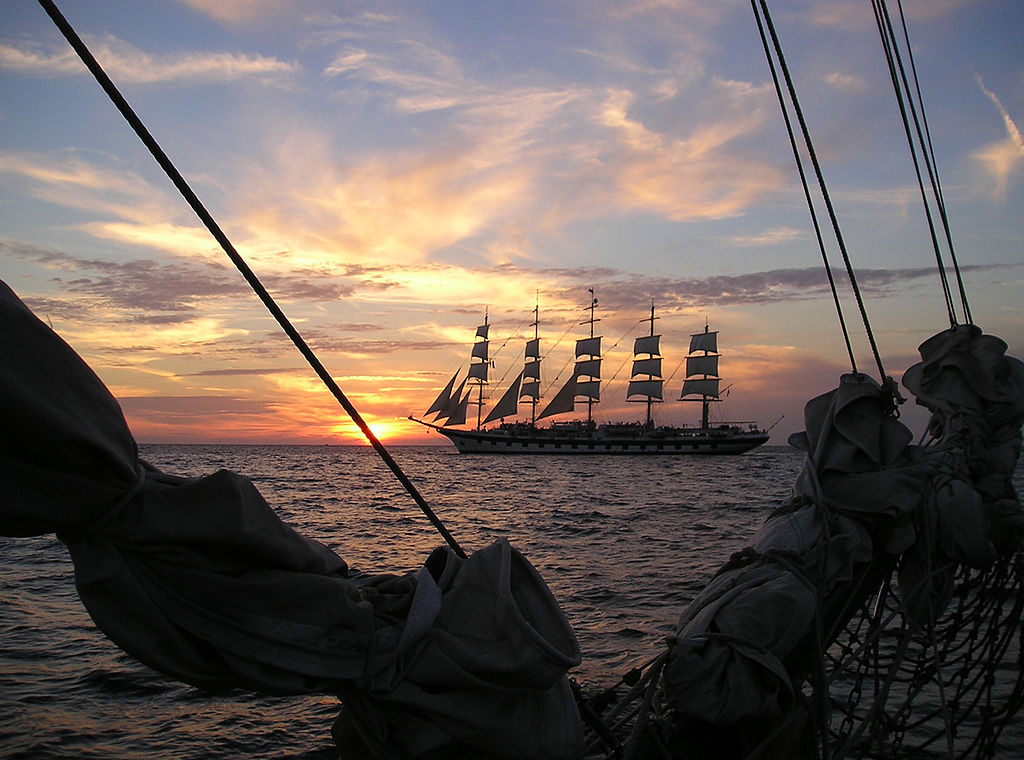
Jacob and Anna Barbara sailed out of Rotterdam on the ship Patience. This ship made annual runs to the port of Philadelphia from 1748 until 1753, with the exception of 1752. Descriptions of this particular ship show it to be a 200 ton, three-masted ship with eight guns and a crew of 16 men. The voyage in 1750 carried 124 men with total passengers of 266. Women and children were not listed by name on the ship’s log. After the ship arrived at Philadelphia, all males over the age of 16 were taken to City Hall to sign the Oath of Allegiance and were then led back to the ship. Those who already had their passage money, or were able to borrow it, were then allowed to leave the ship.
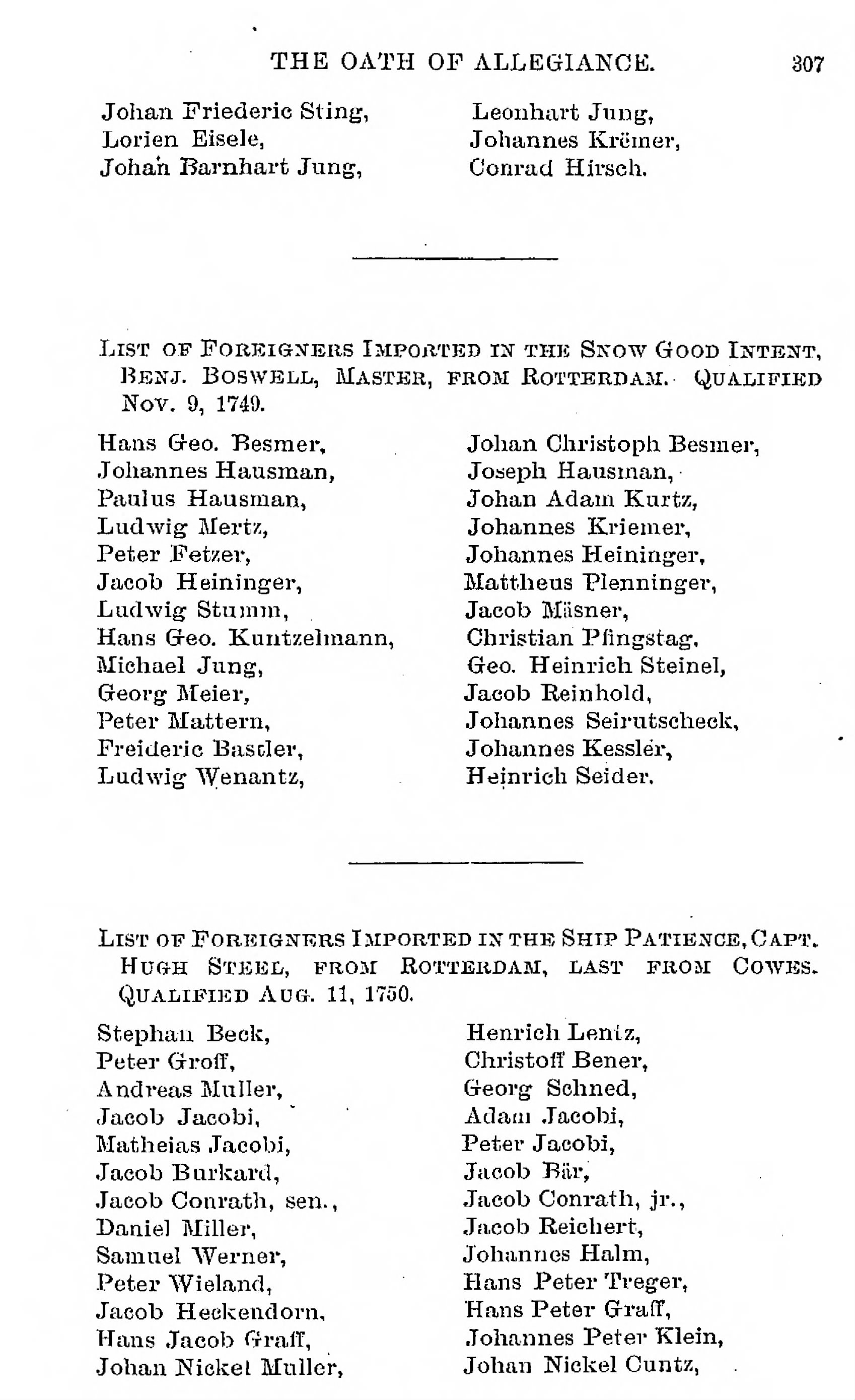
It is likely that Jacob had been in contact with other Swiss-German settlers in the Frederick County, Maryland area because this is where he settled and took up farming after arriving in America. Jacob and Anna Barbara added a son, George, to their family in 1751.
![Virginia and Maryland By Fry, Joshua, 1700 (ca.)-1754 -- Cartographer ;Jefferson, Peter, 1708-1757 -- Cartographer; Jefferys, Thomas, d. 1771 -- Engraver [CC0], via Wikimedia Commons](https://relativityitsallrelative.com/wp-content/uploads/2015/01/earlyvirginia.jpg)
In 1757, during the French and Indian Wars, Jacob is found on the roster of Capt. Stephen RANSBERGER’s Company, Maryland Colonial Militia. Beyond these things, not much is known about the Jacob Heckendorn family. We have not found a record of when Reinhard Jacob, Anna Barbara, or the two daughters died or if those daughters married.
At some point the name morphed into HACKATHORN, at least for my line. I have seen many different versions of the surname spelling including, commonly, Heckathorn and have found some creative spelling on census records as in Hackalhorn. No wonder they’re so hard to find! It appears as if the name Heckendorn may have been derived from the tree we would know as the Hawthorn.
![Snow Covered Hawthorn Tree Walter Baxter [CC BY-SA 2.0 (http://creativecommons.org/licenses/by-sa/2.0)], via Wikimedia Commons](https://relativityitsallrelative.com/wp-content/uploads/2015/01/a_snow-covered_hawthorn_tree_on_buckholm_hill_-_geograph-org-uk_-_1653878-3.jpg)
At some time before the 1800 census, Jacob’s sons, Johann Jacob (known as Jacob Jr. now) and George, left Maryland bound for western Pennsylvania. We find George in Washington County, PA. and Jacob in Beaver County, PA. just about the time of The Whiskey Rebellion. But then, that is another story…
SOURCES:
Sherwin, Ann C. (1981). The Heckathorn Family. Decorah, Iowa: The Anundsen Publishing Company.
Hackathorn, Hollis A. (1996). Of Heckendorns and Heckathorns
Heckathorn, Theodore A. (1983). The Heckendorn- Heckathorn Family in America. Baltimore, MD: Gateway Press
Pennsylvania Archives › Series 2 › Volume XVII › Names of Foreigners who took the Oath of. Allegiance, 1727-1775 › Page 307
Paul A. Darrel. “Immigrant Ships.” The Palatine Immigrant Vol. VII No. 1
http://www.alsace-newyork.com/history
http://www.robert-weinland.org/histo.php?lang=en
http://commons.wikimedia.org/wiki/File%3AMap_commune_FR_insee_code_67288.png
http://upload.wikimedia.org/wikipedia/commons/1/10/Map_commune_FR_insee_code_67288.png
http://commons.wikimedia.org/wiki/File%3AClaude_buffier_map_of_france.JPG
http://commons.wikimedia.org/wiki/File%3AF%C3%BCnfmastvollschiff.JPG
In keeping with the optional themes in Amy Johnson Crow’s 52 Ancestors 52 Weeks Challenge, as soon as I read that this week’s suggestion was “Tough Woman”, I thought of my maternal 2nd great-grandmother Mary Amna MYERS. I have long been more than a little obsessed with pioneer women and have read scads of books and diaries of, and authored by, pioneer women. You can probably imagine my delight at having a copy of an oral history that was dictated by Elizabeth Jane (Jennie) HACKATHORN BROTHERS, daughter of Mary MYERS, to a third cousin of mine, Susan MORGAN ACERBI. Susan has graciously allowed me to quote from that history for this blog post.

Mary Amna MYERS was born 29 December 1831, first-born daughter to Lambert L. MYERS and Susannah CRAWFORD. Although no proof has been found to the place that she was born, it is reasonable to believe that she was born in or near what is now East Township of Carroll County, Ohio since both the MYERS and CRAWFORD families lived in this area during that time. At the time of her birth, this area would have been Columbiana County.
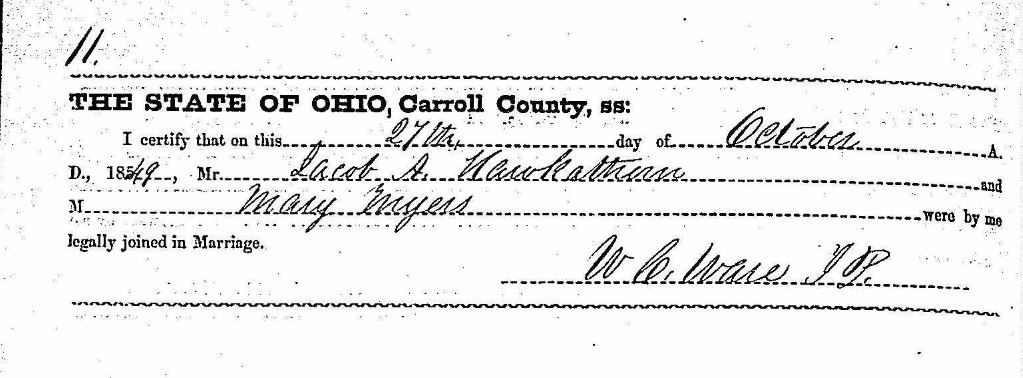
Mary married Jacob A. HACKATHORN on 27 October 1849 in Norristown, Carroll County, Ohio. He was the son of Christian HACKATHORN and Catherine PHILLIS, early residents to this area from Beaver County, Pennsylvania. At the time of the 1850 census, Mary was enumerated twice. First, with her husband, Jacob, and six month old first born, Susannah F., on September 18th in Tallmadge, Summit County, living nearby Jacob’s brother James, and then in the home of her parents, Lambert and Susannah, in East Township of Carroll County on September 24th. Mary’s young daughter is not enumerated with her in the home of her parents. We know that Susannah died in infancy and although the death date has not been found as of yet, it is reasonable to assume that it could have been in this time period. Mary, herself, was pregnant again at the time of the census and due to give birth in December. These two things could have been a reason for her to show up in her parents’ household at the end of September. There would be 12 children born to Mary and Jacob. Besides Susannah, a son also died in infancy, and their youngest born son, George, died at the age of two. The other children were Christian Charles, Jacob P., James L., Silas Myers, William A., Thomas John, Crawford Matthew, Elizabeth Jane, and Katherine Amanda. Although I did find an entry on the 1900 census in Medina County, Ohio listing a Mary HACKATHORN living with her daughter, Amanda of the correct ages, I really have no information about Amanda and am not sure if these are my Hackathorns. I do know that she is not present in the following photograph of those siblings.

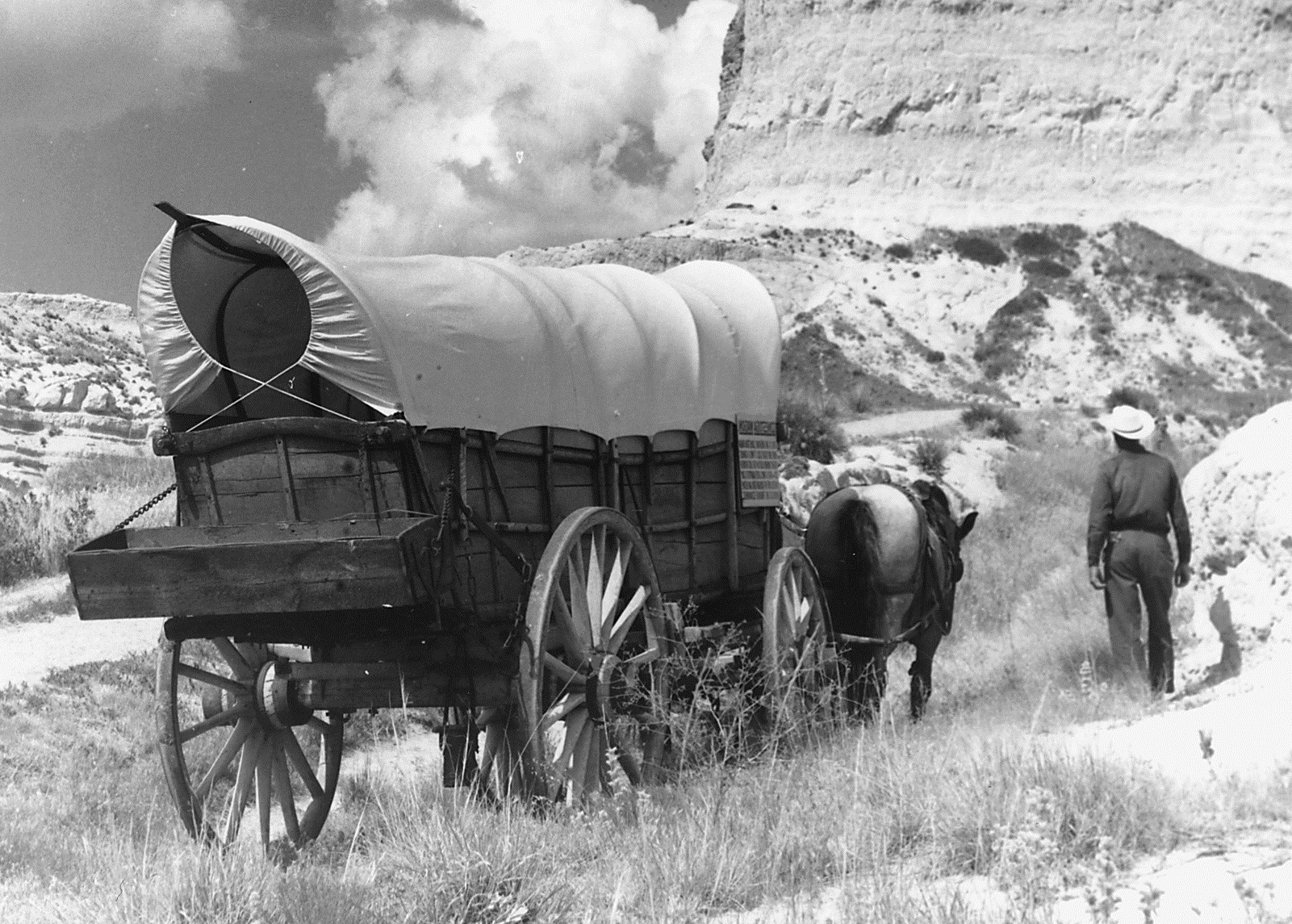
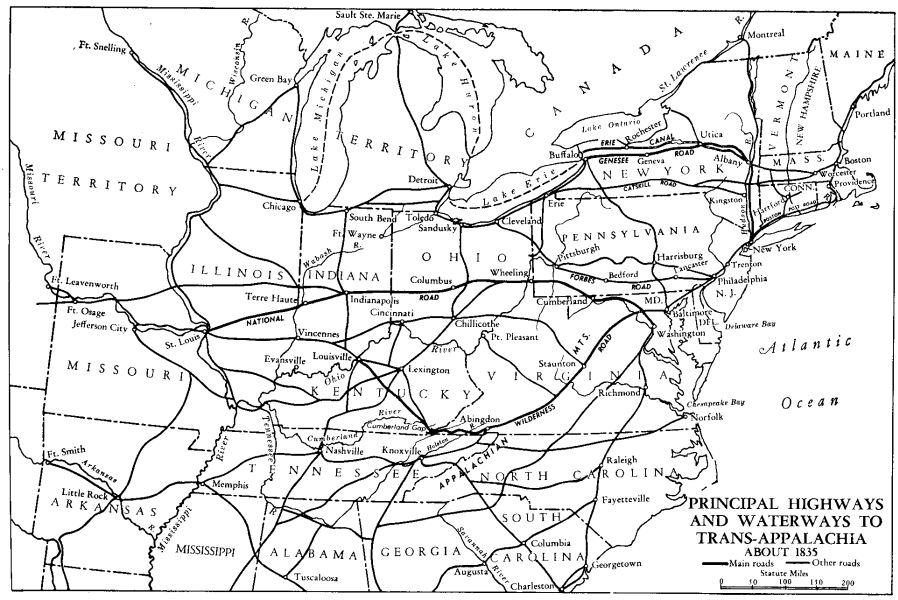
At the time of the next census in June of 1860, we can find Mary and Jacob living in Liverpool Township of Columbiana County with their four young sons; Christian, James, Jacob, and Silas. “Jacob seemed to be a jack-of-all-trades. He farmed, mined coal, did some blacksmithing and various other work. Jacob and Mary thought with their family of growing boys they could do better in the west. So in 1866 they travelled west.” The thought was probably on their minds because of The Homestead Act of 1862 that was signed into law by President Abraham Lincoln on May 20, 1862. Because of their near proximity to The National Road and the areas where we find them along their journey, it’s safe to assume that this is the route that they took in their covered wagons.

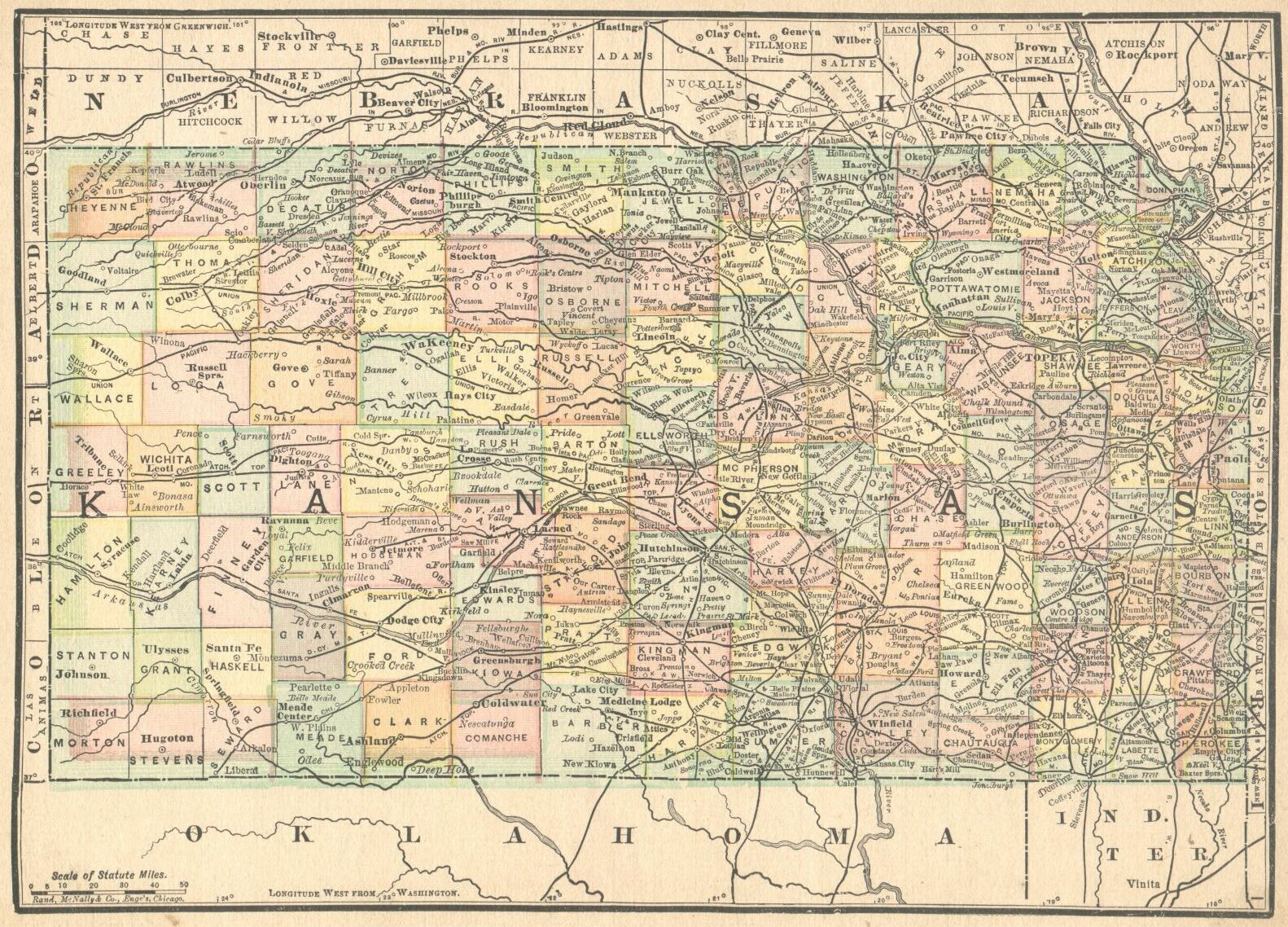
We know that Crawford Matthew was born 21 May 1868 near Batavia, Jefferson County, Iowa and that Jane was also born in Iowa 29 November 1871 so they must have moved to Kansas sometime between the end of 1871 and 1873. “In ’73 and ’74 the hot winds and the grasshoppers took all of the crops, so they decided that was enough of the West and they started back East in covered wagons. They got as far as Indiana and met an old farmer who needed help on his farm. He made them a good proposition and Jacob, with his sons James, Jacob, and Silas; the three who were large enough to work (Christian having married and stayed in Kansas) decided to work for the farmer.”
Back in Kansas, Christian had married Harriet GLENN on 16 April 1874 in Greenwood County. On the 1875 State Census of Kansas, we find Christian and his young family living in Osage County, Kansas. I don’t know if this is the area in which the Hackathorn family originally settled in Kansas, but in all probability it was.
“Their big difficulty was no house to live in. With the help of the good neighbors, they built a two room house, one room up and one room down. They cut the logs and went to work on the house and in the meantime they lived in the two covered wagons. Luckily, it was summertime. This farm was in the Wabash bottom and they burned dry toadstools to smoke the mosquitos away. On their way back East, Jane being between three and four years old, has a vivid recollection of seeing a large herd of buffalo. She said they looked like a large body of waving water. They (the buffalo) were crossing the trail and the wagons had to wait until they had passed. Jane said they could not see either end of the herd. They did not see any Indians, but were always on the lookout for them. Water was very scarce, but when they came to the Mississippi River, Jane thought that was too much water. They had to cross on a ferry boat and the noise of the engines frightened the team of mules and the boys jumped from the wagons to hold the mules and, in doing so, had to pay extra fares. They got as far as Indiana where they built the log house. The crops were doing nicely and everything was going fine, when in August they had a torrential downpour. The levee broke and that lowland was soon flooded and everything was washed away. They had no time to rescue the animals so waded to the stable and loosened them so they could take care of themselves as best they could. The family moved everything to the second floor and waited to be rescued. They were taken out in a john boat and traveled at least seven miles before they hit dry land. Then they stayed in a blacksmith shop overnight and were chased from there before daylight as the water was still rising. Jane does not remember just how they got out of the predicament, but she does remember that after the water went down, the men folks went to look for the animals. They found the team of mules, one on each side of the river. They found the horses, one was dead, but they still had one team left. This seemed like the end of everything for they had lost three crops three years in succession and they were still destined for still more bad luck.”
The Hackathorns were probably living just west of Terre Haute, Indiana at the time of this flooding of the Wabash River in August of 1875. This area is convenient to The National Road and we find them in this area for a few years. The newspapers of that time are full of reports of the flooding and I did find this article that mentions a destructive tornado that went through a county just north of this area at that same time.

“They then found a place to live near Saline City and still kept the family together. Jacob and the boys worked at whatever they could find to do until June of 1876 when Jacob, the father, contracted smallpox and died.” Historic Note: This is the same month and year of Custer’s Last Stand. “They all had smallpox except for James who was working away from home. Mother Mary and the children were vaccinated as soon as they knew the father had the disease and, of course, it was not so severe with them. There was at this time a real epidemic of smallpox in that territory and no one would go near a house that had sickness, for everyone was afraid of the dreaded disease. This made a hardship on the family for no one would give them work even after the quarantine was lifted. Jane remembers that while they were sick they lived on tea and crackers which the county sent them. One family of good neighbors by the name of ICKES gave them milk but would not go near the house. One of the boys would set a pail out in a field and the neighbors would pour milk into the pail and then raise a flag to let them know it was there. The neighbors dug the grave for father Jacob and the casket was brought to the yard and left there. The boys then carried it into the house and Mother Mary and the boys placed him in it and took him to a county cemetery they called the Skee Cemetery and buried him. The daughter of the ICKES family afterward married James HACKATHORN. Her name was Lyde.”
In the 1880 census, we find Mary and her sons, Jacob and William, living in Sugar Creek, Vigo County, Indiana, west of Terre Haute. Not so far away, is the farm of James SKEE and family. I have not found a cemetery by the name of Skee Cemetery in searches and in letters written to historical societies in Indiana. It is reasonable to assume that Jacob was buried in a family cemetery on James SKEE’s farm. I have no idea where the younger children are on the 1880 census since they were not enumerated with Mary and the two boys and I have not found them living with known family members, nor could they be found with neighbors; however, the family eventually migrates down to and meet in Bergholz in Jefferson County, Ohio where the children marry and start families. This includes Christian, who left Kansas and brought his young son along with him after his wife died in 1887. This did not include James who remained in Indiana with his wife and daughter, Lillian. Mary died in Bergholz on 30 December 1896 at the age of 65 years old and is buried in the Bergholz Cemetery. A pioneer woman in every sense.

Sources:
Special thanks to Susan Acerbi who had the forethought to record this oral history of the Hackathorn journey to the west with Elizabeth Jane Hackathorn (Jennie Brothers) and for giving me permission to reproduce parts of it. Thanks, Susan!
Year: 1860; Census Place: Liverpool, Columbiana, Ohio; Roll: M653_948; Page: 161; Image: 326; Family History Library Film: 803948
Year: 1850; Census Place: Tallmadge, Summit, Ohio; Roll: M432_732; Page: 483B; Image: 439
Database online. Year: 1850; Census Place: East, Carroll, Ohio; Roll: M432_664; Page: 154B; Image: .
Year: 1880; Census Place: Sugar Creek, Vigo, Indiana; Roll: 318; Family History Film: 1254318; Page: 184A; Enumeration District: 199; Image: 0370
com, Kansas State Census Collection, 1855-1925, (Provo, Utah, USA)
“Ohio, County Marriages, 1789-1997,” index and images,FamilySearch (https://familysearch.org/pal:/MM9.3.1/TH-1-18084-100791-52?cc=1614804 : accessed 18 January 2015), Jefferson > Marriage index and records 1896-1899 vol 14 > image 293 of 432; county courthouses, Ohio
http://upload.wikimedia.org/wikipedia/commons/2/25/Conestoga_wagon_on_Oregon_Trail_-_NARA_-_286056_crop.jpgBy Conestoga_wagon_on_Oregon_Trail_-_NARA_-_286056.jpg: Department of the Interior. National Park Service. Scotts Bluffs National Monument. derivative work: Crisco 1492 [Public domain], via Wikimedia Commons
http://www.kshs.org/kansapedia/settlement-in-kansas/14546
http://www.kshs.org/kansapedia/homestead-act/15142
http://www.connerprairie.org/Learn-And-Do/Indiana-History/America-1800-1860/The-National-Road.aspx
http://www.historynet.com/1874-the-year-of-the-locust.htm
The Indiana State Sentinel., August 05, 1875, Page 6, Image 6
For those of you who may have stumbled upon this blog thinking that you were going to be reading about Albert Einstein, or physics theories, or anything along those lines – you might want to just click away from this page. I am using more than a bit of Artistic License with the title. This blog is born from the brainchild of Amy Johnson Crow over at www.nostorytoosmall.com who ran a 52 Ancestors in 52 Weeks challenge in 2014. Sadly, I missed out on that one. This then, is me stepping up to the challenge for 2015. I can’t think of a better place to start than with my grandmother, Elsie Marcella HACKATHORN.

Elsie is my maternal grandmother, born on the first day of January, 1908 in Bergholz, a little coal-mining town in east central Ohio. It was the first year ever that the ball that signifies a new year was dropped at Times Square in New York City, the American flag only had 45 stars, Theodore Roosevelt was President, and the horseless carriage was just starting to catch on. She married David MOORE in 1923 in Wellsburg, WV. She told me once that she was really happy to have lived in the time that she did because when she was born “there were hardly any cars and now you can go to the moon and back”.
When people remember Grandma, they usually always mention that she was always smiling. When I remember her, I remember sitting knee-to-knee with her while she taught me to knit and crochet. She was left-handed, I was not, and it was like learning in a mirror. She made her own patterns for the dresses that she sewed for herself, made patchwork quilts, worked crossword puzzles, and read. But, most importantly, she liked to talk about family long gone. She wasn’t the hug you, bake you cookies, and fuss over you kind of grandmother, she was the talk to you like a person kind of grandmother and that’s what I liked about her.
I could write page upon page about Grandma, but the point in introducing her now is to give her credit for my own interest in our family’s history and in genealogy. When you’re younger, you believe that you’re going to remember everything about a story. How sad it is when you realize that you should have written down or tape recorded those conversations because they fade and disappear with time. And then they’re just…gone.
The same is true of people. If there is nothing written down, no photographs, nothing to jog the memory then they, too, fade from memory and disappear. I wish that my grandmother was still with us, especially with DNA testing. She would be so very interested! I could also tell her about how far I’ve come in tracking down some elusive ancestors lately and she would be delighted.
And, so…this year, this blog, I’m dedicating to you Granny.

Stories of the American West | Cowboy History & Western Culture
The 1,000 mile coastal history hike. For people with fear of heights and interest in 2,500 years of living on the sharp edge of land and sea
Genealogy, the law and so much more
News and resources covering social media, search engines, databases, archives, and other such information collections. Since 1998.
Adventures in Genealogy
Genealogy and History in North Carolina and Beyond
Decluttering the Stuff to Live a Decluttered Life
musings of a frequent flying scientist
Exploring Ohio History One Marker At A Time
Be Strong. Be Nourished. Be Mindful. Be Beautiful.
The Art and Craft of Blogging
Reading and Writing about Appalachia
Revealing humanity, one story at a time
Sorting it out one load at a time
by Tim Nichols
 RELATIVITY