
Tombstone Tuesday is a GeneaBloggers Prompt

It's all relative…
Tombstone Tuesday is a GeneaBloggers Prompt


Week #11’s 52 Ancestors post is more than a little late and I’m afraid that the only excuse that I have is that with the plethora of Irish research site links posted across the internet over the past week, I felt compelled to investigate many, many of them (and there is only so much free time).
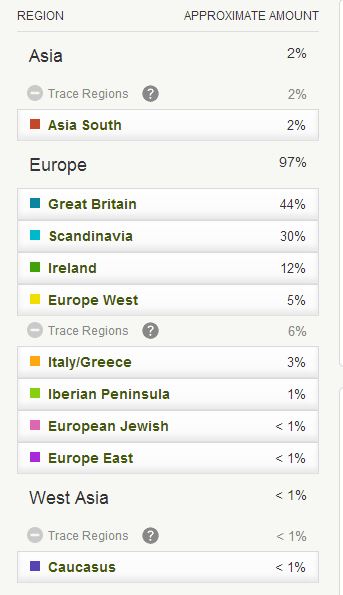
My family never leaned toward any cultural or ethnic traditions while I was growing up. I had lots of friends who had those type of family traditions, but we never did. We were just people who lived in Ohio. Because of my auburn hair, fair skin, blue eyes, and smattering of freckles across my nose, I had been asked many, many times in my life if I was Irish – usually around St. Patrick’s Day. I have usually replied that maybe I was, just a little. I really had no idea. Most of my lines, both maternal and paternal have been kicking around the U.S. for hundreds of years, so I think that would make me mostly an American with a heavy dose of European and Scandinavian roots. Now, thanks to DNA testing estimates, I found that indeed I am a bit Irish – approximately 12% worth. There are certainly surnames in my tree that have the appearance of being Irish, but I have always assumed that these people were probably Scotch-Irish. The problem is that all of these Irish sounding ancestors have been here in America forever. Seemingly so, anyway, since I’m not having much luck tracking down the immigrant ancestor for these lines and the records in Ireland are sketchy, at best, pre-1843.
My maternal grandfather Moore’s death certificate stated that he was Irish/American Indian. But then, that’s what my grandmother told them as the informant and that’s the story that he told her. So far, the Native blood hasn’t surfaced, but he did have black hair, darker skin, and eyes that were so brown that they looked black. Moore’s can be Irish. I did a lot of reading seeking information about what exactly the term “Black Irish” means, but it seems that there is no definitive answer on that. It also seems that there is really no answer about what “Luck of the Irish” means, either. Is that bad luck? Is that good luck? So many questions.
After all of my fruitless searching this week, I decided to put Susannah Crawford out here as blatant “cousin bait”. This is one of my huge brick walls that has a bunch of circumstantial evidence, so let me tell you what I know and don’t know. Susannah is my 3rd great-grandmother. She is the mother of Mary Amna Myers, who married Jacob Hackathorn. According to the 1900 census, Susannah was born in February of 1815. This is very consistent with ages given in all other censuses since 1850. In fact, the very consistency with Susannah’s information is why I’m writing about her this week. In giving information to the census enumerator, she always states that both of her parents were born in Ireland (and that fact has also been part of family tradition) and her age is always consistent with the progression of the census years. There is a researcher in Augusta, Ohio who states that Susannah is daughter of Matthew Crawford and a Susannah. As of this writing, no proof of that exists. I had always taken Susannah to be a daughter of one of Matthew’s sons, either William, Matthew, John, or James. My initial reasoning was circumstantial, at best. All of these people lived relatively nearby each other between Augusta and Norristown in Carroll County. These families also lived nearby the family of Silas Myers and all had settled in Columbiana County early on (this part of Columbiana County became Carroll County in 1832 on December 25).
![Donegal Bay. Kelisi at the English language Wikipedia [CC-BY-SA-3.0 (http://creativecommons.org/licenses/by-sa/3.0/) or GFDL (www.gnu.org/copyleft/fdl.html)], from Wikimedia Commons](https://relativityitsallrelative.com/wp-content/uploads/2015/03/donegalbaycloseup.jpg)
Matthew Crawford, Susannah’s suspected father, was born about 1750 in County Donegal, Ireland. County histories all seem to agree that he immigrated to America in 1803 or 1804 and settled in Washington County, Pennsylvania accompanied by his four sons William, Matthew, John, and James and their families. James’ birth has been stated to be in Drumhome Parrish, County Donegal. A diligent search of ship’s passenger lists from Ireland from 1802 until 1805 have, so far, failed to produce these Crawford families. While son William remained in Pennsylvania, between 1810 and 1820 Matthew and sons Matthew, John, and James removed to the Augusta Township area and the three boys entered 160 acres of land each.
It appears that Matthew, the father, did not purchase land. Although, apparently, he was living in Augusta Township and “spent his last days on this land”. Matthew has sometimes been associated with two younger daughters – Rebecca, born in 1787 and Mary, born in 1791. The mother of the boys is probably named Margaret Letta Brown (or Lettie). Indeed, in the 1810 census where we find him in Washington County, Pennsylvania, the household would appear to reflect this. I have not found Matthew in the 1820 census in Ohio. The Matthew that is attributed to being Matthew, the father, in several trees for the 1820 census I believe to be Matthew the son because of ages of the males. Information for if, and when, Matthew married a Susannah – who would be my Susannah’s mother – has not been found and neither has what happened to her after Matthew died, assuming that he passed before her. I even put out an S.O.S. to the Carroll County Facebook page to see if anyone there might be related to the Crawford or Myers family and still hanging out in the area. No luck.
During these past two weeks I have systematically gone through the 1850 through 1880 censuses noting the sons of Matthew and their families. First, to get them straight because they continue to repeatedly use the same names for their children (and occasionally, using the names again if a young child dies). And secondly, to make sure that Susannah, my 3rd great-grandmother, doesn’t turn up as one of their children. Excepting Matthew, the father, it has also been relatively easy to find the wills of these people through probate records and my Susannah has not turned up as being named as a child in any of these wills. So…speculatively, Matthew, born in County, Donegal, Ireland is going to be who I’m working with as Susannah’s father.
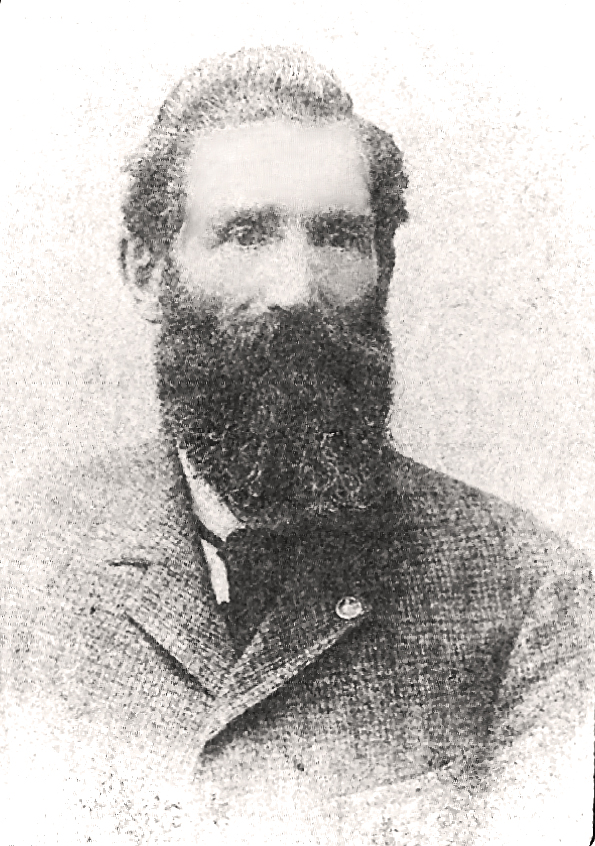
Susannah Crawford married Lambert Myers, son of Silas Myers and Catherine Eads, on 14 September 1830 in Columbiana County, Ohio.

Susannah gave birth to eleven children who survived to adulthood, 3 daughters and 8 sons.
Between the 1850 and 1860 censuses, Susannah and Lambert moved to the East Liverpool area from Carroll County and would live out the rest of their lives in that vicinity. Lambert passes away sometime after the 1880 census. No death certificate or burial site has been found, as of yet, for him. We find Susan living with her daughter, Margaret Elizabeth, 83 years old and widowed, in the 1900 census. This daughter had lived nearby Lambert and Susannah for many years. The 1904 East Liverpool City Directory lists Susannah living just around the corner from Martha Elizabeth in a room at 118 Jackson Square and then she passes away 24 July 1904 and is buried in Spring Grove Cemetery in East Liverpool, Ohio.
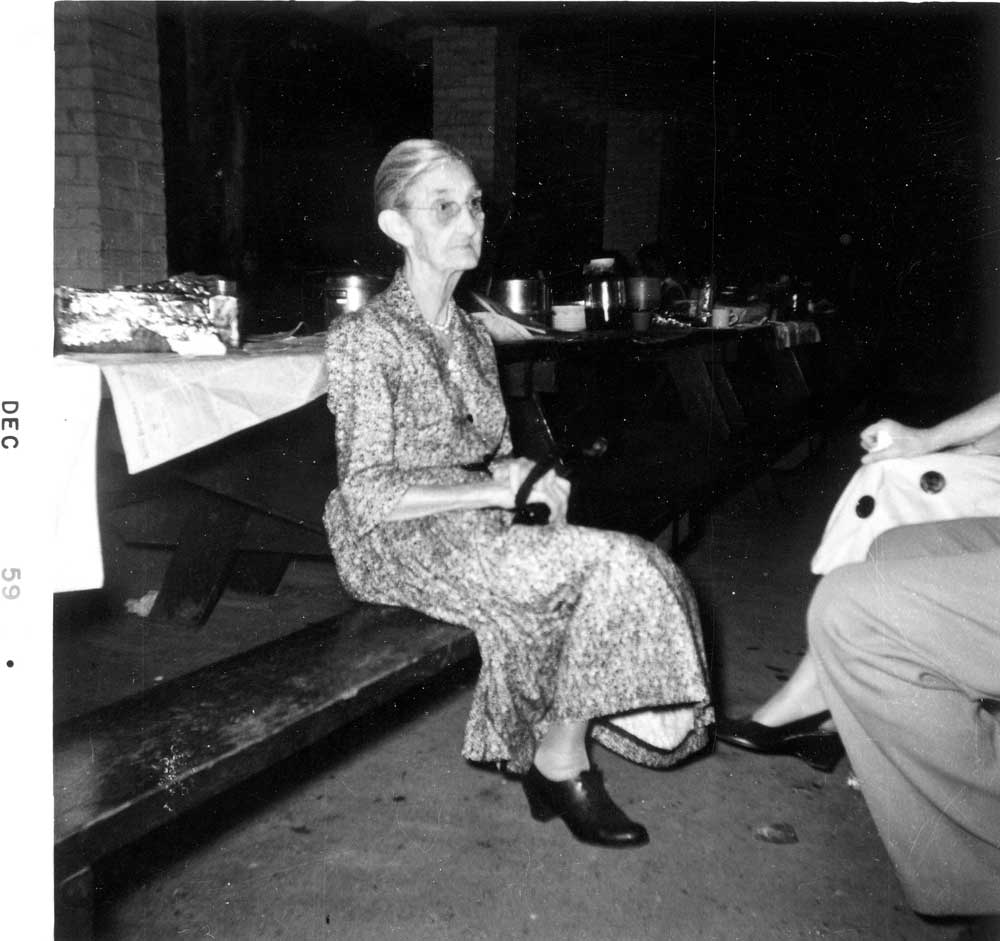
I don’t have a positive identification on most of the women in the photograph of Susannah at the beginning of this post. We know that Susannah is sitting front center and standing behind her, slightly left is her daughter Margaret Elizabeth. Susannah had three daughters, and because of the similarities between the woman sitting on left and standing far right to Margaret, I have to believe that the one standing is daughter Katherine and the one sitting in front is daughter Mary. Katherine had two daughters, Minnie G., born 1868 and Mary Susan, born 1870, and it is possible that these two young girls pictured beside and in front of the supposed Katherine in the photo could be those daughters. Because of the clothing styles, it is not unreasonable to think that this photograph could have been taken somewhere between 1880 and 1887, but what the heck would Mary be doing in East Liverpool when she was living in Indiana at that time? One possibility might be that everyone was in town because of the death of Lambert. One might think that Susannah does not look the age of a woman who might be a couple of years either side of 70 in this photo, but some of the women in our family wear their age incredibly well. I really have no idea who the women standing on far left might be. Perhaps they are wives of Susannah’s sons? Perhaps more photographs of the family will surface in the future and we will be able to identify all of these women. Hopefully. So many questions…

This is my Week #11 post for Amy Johnson Crow’s
52 Ancestors 52 Weeks Challenge.
The optional theme for this week was “Luck of the Irish”.

THE FLOOD
1828 versus 1875
Destruction and Devastation
“Water, water everywhere! There are few of our citizens who do not know of the extent to which the classic Wabash has, in past years, risen, and but few who have not felt the effects of it in a greater or lesser degree; but such an occurrence as the present rise – the magnitude of which has never been witnessed by any one living – claims more than just a passing notice. January and June freshets used to be looked for in times past, as regularly as those months came round, but for such a rise as the present to pour down upon us in August, is unprecedented and will probably never again be witnessed. The well-remembered rise of 1828 is no longer a data, as the rise of August, 1875, which reached its highest point last Tuesday, saw it and went twelve inches better. The flood of 1828 can now step down and out, and those old citizens who boasted of having seen the Wabash at such height as has never been reached since, and probably never before, will have to keep in the shade and yield to their descendants the “glory” they have themselves so long enjoyed. At this writing, Wednesday evening, or town is surrounded with water…”

Thomas John Hackathorn, my great-grandfather, was a boy of ten years old when his family was caught in the midst of this flood. You can read more about the family’s experience here in the week three posting of the 52 Ancestors Challenge. I am trying to imagine the destruction of the flood through the eyes of a boy and wonder if he was scared, or if he found it exciting, or perhaps a bit of both? It is a little difficult reconstructing Thomas’ life after the flood. We know that his father, Jacob, contracted smallpox and died within ten months of the flood. The oral history account of this time given by Thomas’ younger sibling, and only sister, Jennie, states that they were able to keep the family together after the flood, but what happened after the death of their father in June of 1876 is pretty much unknown.
As was mentioned in week three, Christian had remained in Kansas when the family started their journey back East after successive years of crop failures. James married the Ickes neighbor, Lyde in 1879. At the time of the 1880 census, we find James and Lyde living not too far from James’ mother, Mary, in Vigo County, Indiana. We also find Mary with two of her sons, Jacob and William. Silas is working as a farm hand and boarding there, also in Vigo County. But where are the three youngest children, including Thomas? Thomas, Crawford, and Elizabeth Jane (Jennie) are nowhere to be found. I have searched the 1880 census for years looking for some clue to where they might be. I looked for those children in the households of grandparents, aunts and uncles, and cousins in Indiana, Michigan, Pennsylvania, Iowa, West Virginia, and Ohio. I’ve undertaken what amounts to a door-to-door search in Vigo County, Indiana thinking that they might have been farmed out to neighbors. I’ve searched orphanages and asylums without finding a trace. I don’t know if, perhaps, they had been placed under some sort of guardianship after the death of their father or not because I have not found any documents or newspaper articles to that note. They just…disappeared.
This is not the first time that I’ve had problems finding this particular family. I have yet to find them in the 1870 census. After searching for many variants of the Hackathorn surname, including, but not limited to, Heckathorne, Hagglehorn, Hickenhorn, Hackleborn, Hakeltorn, and Headstrom (yes, indeed, Headstrom), I have convinced myself that the family was probably traveling in their covered wagon somewhere in Missouri or Kansas at the time of the census in 1870. What we have are about 30 years where we know almost nothing about where the family was living and what they were up to.
Thomas John Hackathorn was born on Sunday morning, 16 April 1865. It was Easter day and the nation was still in shock at the assassination of Abraham Lincoln. Just the week before, Lee had surrendered to Grant, the Civil War was winding down, and Jacob and Mary were itching to leave Ohio and try their fortune out West. In 1866 they began their westward trek with their older sons and year old Thomas in tow.

Until we can fill in the missing years after the flood in Indiana, we can pick up the siblings’ lives again when they have all reappeared back in Ohio – with the exception of James, who remained in Indiana. We know that, at least, William was back in Ohio when he married in 1884. Silas married in 1886. Widowed Christian was back in Ohio from Kansas and married in July of 1893. Jennie married in 1893 also, followed by Crawford in 1895, and Jacob in 1898. Thomas’ mother, Mary, passed away in Bergholz in December of 1896. Thomas John married Florence D. Paisley on 18 June 1893 in Jefferson County, Ohio.
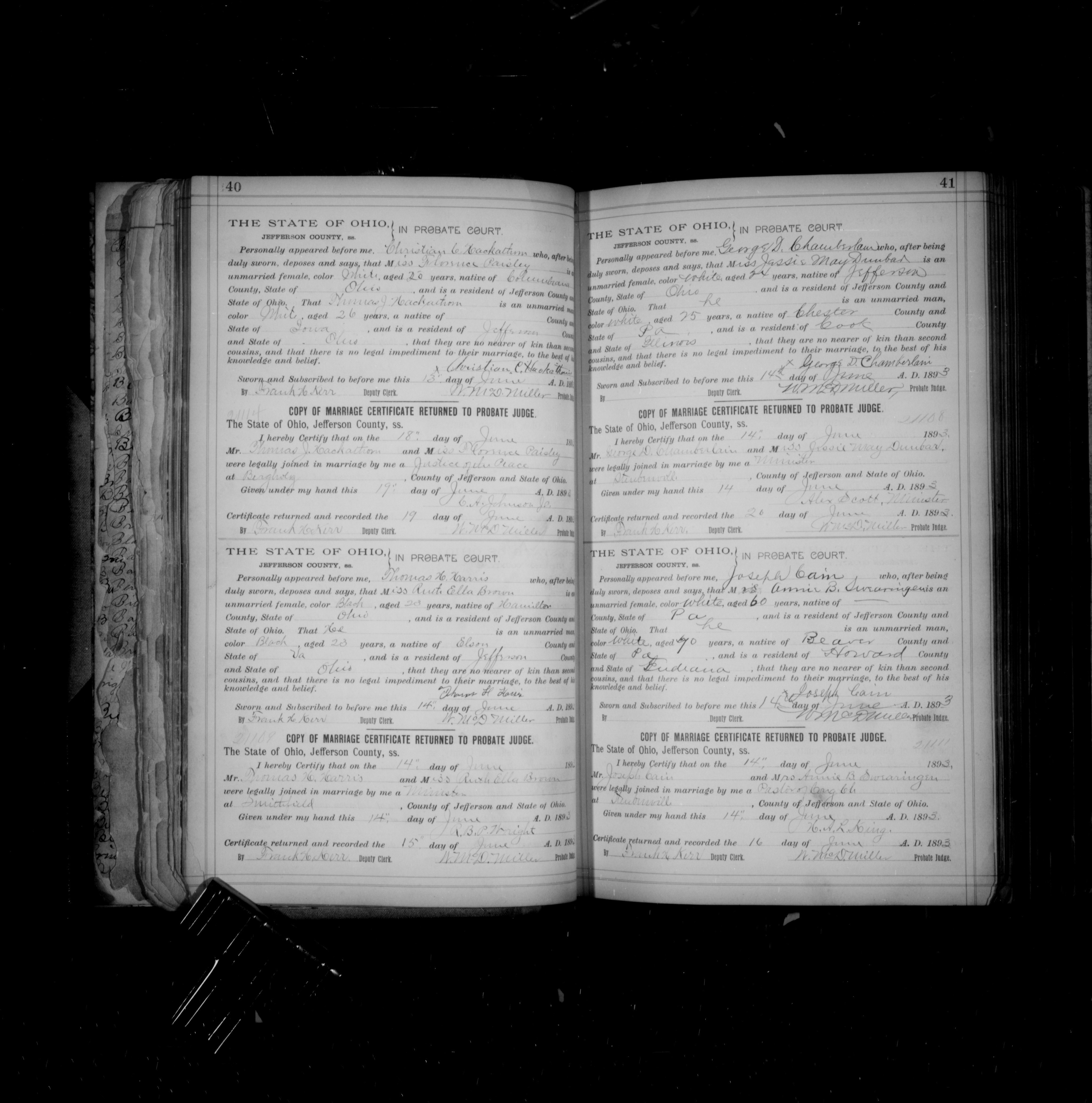

Thomas and “Flora” were married just weeks shy of 24 years when Florence died in childbirth with her 15th child, who was born premature. Of their children, only nine survived to adulthood. After his wife’s death, their oldest daughter, Mary, 23 and a teacher, assumed the role of caring for the eight younger children. His entire adult life, Thomas had been a coal miner and, apparently, a moonshiner and bootlegger. Perhaps the rest of the family knew this fact, but I did not until a few years before my grandmother died. One Saturday we were at Grandma’s apartment because my son had to interview someone for a project at school. He chose his great-grandmother. I was sitting on a footstool glancing at a book and listening with half an ear (because I had already heard a lot of the stories) when my son asked what her father did and she revealed this little tidbit. Surprised is not the word for my reaction. I jumped up and said “Grandma, why haven’t you ever told us this before?” And she replied that it wasn’t something that you usually mention in polite company and how did we think that her father fed nine kids? Not from the coal mines…


It appears from talking with various cousins that the production of whiskey was something of a family affair and that there was most certainly a connection to the Whiskey Rebellion in Western, Pennsylvania. (But, that…is another story.)

Thomas died 25 April 1949 of a cerebral hemorrhage at 84 years of age. He is buried in the Bergholz Cemetery.


This is my Week #10 post for Amy Johnson Crow’s
52 Ancestors 52 Weeks Challenge.
The optional theme for this week was “Stormy Weather”.
SOURCES:
“Ohio, Deaths, 1908-1953,” index and images, FamilySearch (https://familysearch.org/pal:/MM9.3.1/TH-266-12456-7689-20?cc=1307272 : accessed 11 March 2015), 1949 > 22101-25300 > image 2399 of 3533
http://www.ushistory.org/us/34f.asp
http://www.civilwar.org/battlefields/appomattox-courthouse/appomattox-court-house-history/surrender.html
Year: 1880; Census Place: Sugar Creek, Vigo, Indiana; Roll: 318; Family History Film: 1254318; Page: 184A; Enumeration District: 199; Image: 0370
“The Flood.” New Harmony Register 14 Aug. 1875: 3. Web. 11 Mar. 2015.
“Pleads Not Guilty.” Zanesville Times Recorder 29 May 1939: 6. Web. 11 Mar. 2015.
“Several Plead Guilty Before Federal Judge.” Elyria Chronicle Telegram 13 June 1939: 1. Web. 11 Mar. 2015.
In keeping with the optional themes in Amy Johnson Crow’s 52 Ancestors 52 Weeks Challenge, as soon as I read that this week’s suggestion was “Tough Woman”, I thought of my maternal 2nd great-grandmother Mary Amna MYERS. I have long been more than a little obsessed with pioneer women and have read scads of books and diaries of, and authored by, pioneer women. You can probably imagine my delight at having a copy of an oral history that was dictated by Elizabeth Jane (Jennie) HACKATHORN BROTHERS, daughter of Mary MYERS, to a third cousin of mine, Susan MORGAN ACERBI. Susan has graciously allowed me to quote from that history for this blog post.

Mary Amna MYERS was born 29 December 1831, first-born daughter to Lambert L. MYERS and Susannah CRAWFORD. Although no proof has been found to the place that she was born, it is reasonable to believe that she was born in or near what is now East Township of Carroll County, Ohio since both the MYERS and CRAWFORD families lived in this area during that time. At the time of her birth, this area would have been Columbiana County.
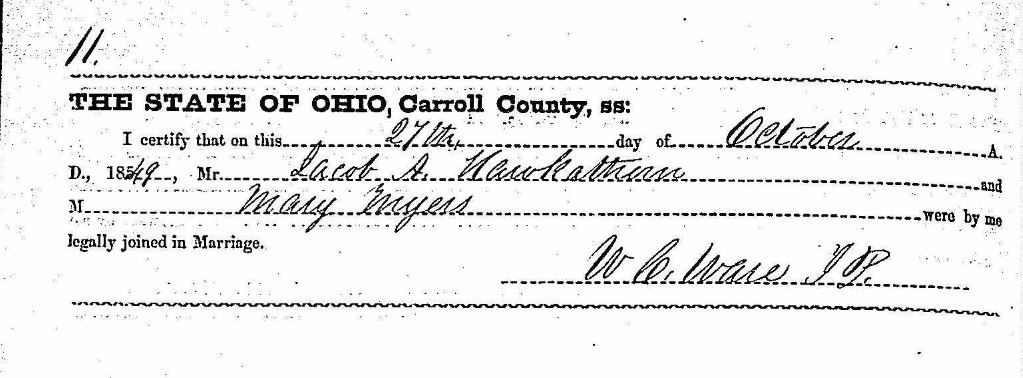
Mary married Jacob A. HACKATHORN on 27 October 1849 in Norristown, Carroll County, Ohio. He was the son of Christian HACKATHORN and Catherine PHILLIS, early residents to this area from Beaver County, Pennsylvania. At the time of the 1850 census, Mary was enumerated twice. First, with her husband, Jacob, and six month old first born, Susannah F., on September 18th in Tallmadge, Summit County, living nearby Jacob’s brother James, and then in the home of her parents, Lambert and Susannah, in East Township of Carroll County on September 24th. Mary’s young daughter is not enumerated with her in the home of her parents. We know that Susannah died in infancy and although the death date has not been found as of yet, it is reasonable to assume that it could have been in this time period. Mary, herself, was pregnant again at the time of the census and due to give birth in December. These two things could have been a reason for her to show up in her parents’ household at the end of September. There would be 12 children born to Mary and Jacob. Besides Susannah, a son also died in infancy, and their youngest born son, George, died at the age of two. The other children were Christian Charles, Jacob P., James L., Silas Myers, William A., Thomas John, Crawford Matthew, Elizabeth Jane, and Katherine Amanda. Although I did find an entry on the 1900 census in Medina County, Ohio listing a Mary HACKATHORN living with her daughter, Amanda of the correct ages, I really have no information about Amanda and am not sure if these are my Hackathorns. I do know that she is not present in the following photograph of those siblings.
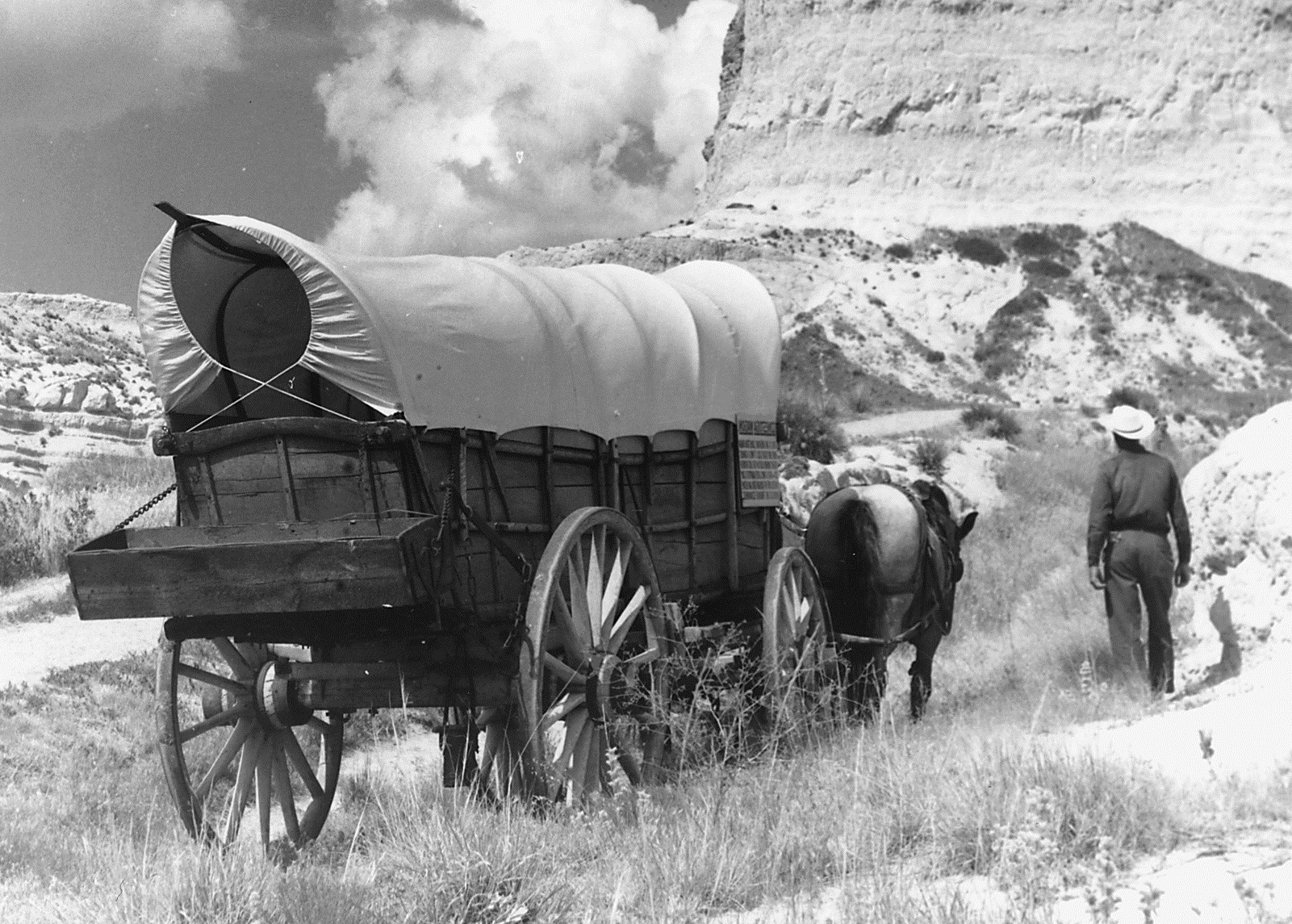
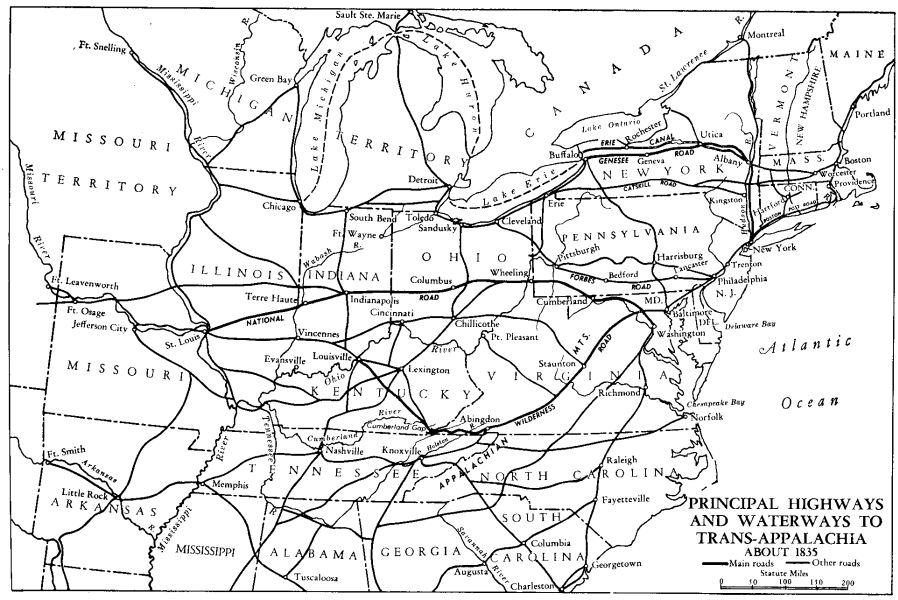
At the time of the next census in June of 1860, we can find Mary and Jacob living in Liverpool Township of Columbiana County with their four young sons; Christian, James, Jacob, and Silas. “Jacob seemed to be a jack-of-all-trades. He farmed, mined coal, did some blacksmithing and various other work. Jacob and Mary thought with their family of growing boys they could do better in the west. So in 1866 they travelled west.” The thought was probably on their minds because of The Homestead Act of 1862 that was signed into law by President Abraham Lincoln on May 20, 1862. Because of their near proximity to The National Road and the areas where we find them along their journey, it’s safe to assume that this is the route that they took in their covered wagons.

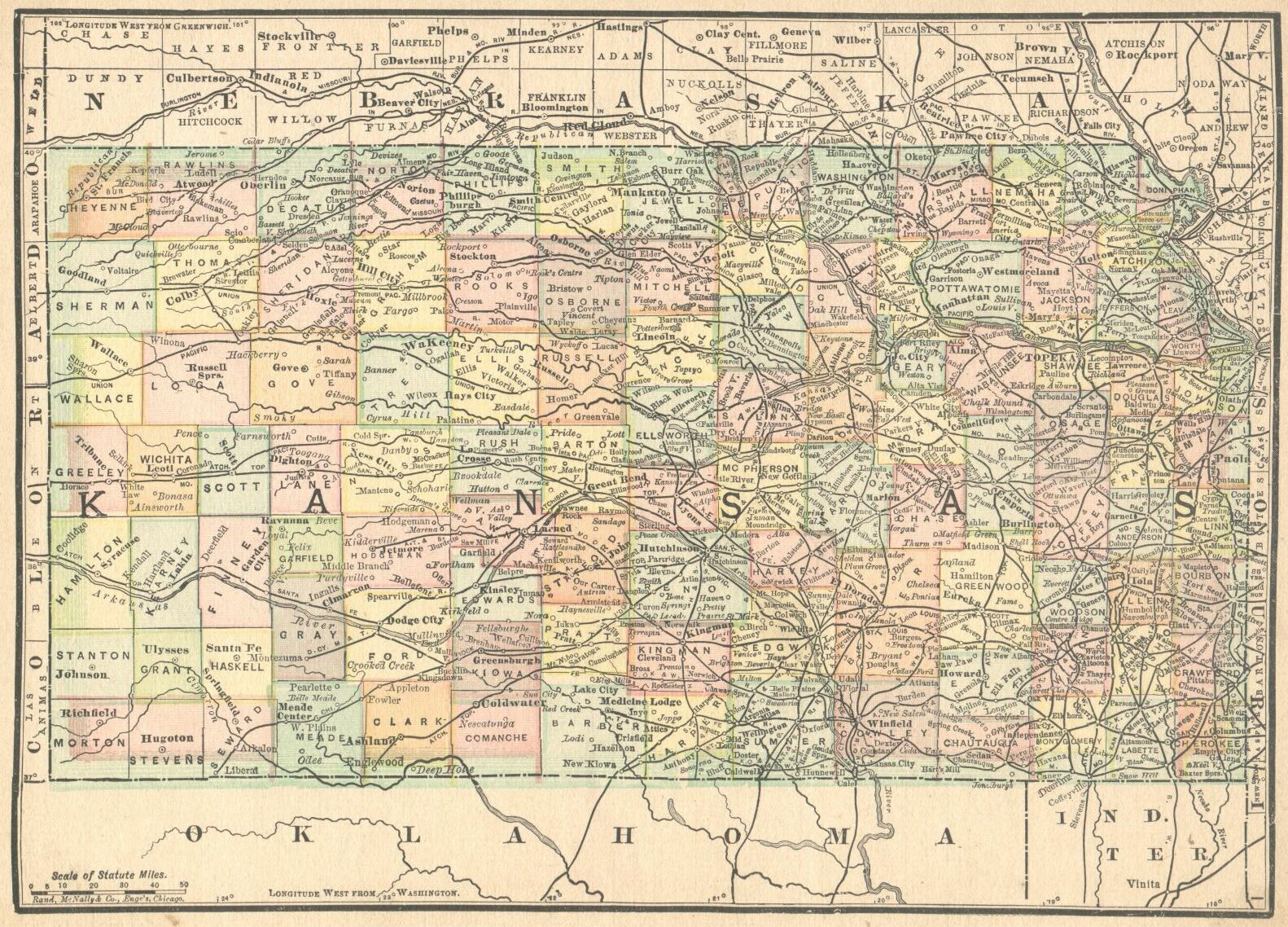
We know that Crawford Matthew was born 21 May 1868 near Batavia, Jefferson County, Iowa and that Jane was also born in Iowa 29 November 1871 so they must have moved to Kansas sometime between the end of 1871 and 1873. “In ’73 and ’74 the hot winds and the grasshoppers took all of the crops, so they decided that was enough of the West and they started back East in covered wagons. They got as far as Indiana and met an old farmer who needed help on his farm. He made them a good proposition and Jacob, with his sons James, Jacob, and Silas; the three who were large enough to work (Christian having married and stayed in Kansas) decided to work for the farmer.”
Back in Kansas, Christian had married Harriet GLENN on 16 April 1874 in Greenwood County. On the 1875 State Census of Kansas, we find Christian and his young family living in Osage County, Kansas. I don’t know if this is the area in which the Hackathorn family originally settled in Kansas, but in all probability it was.
“Their big difficulty was no house to live in. With the help of the good neighbors, they built a two room house, one room up and one room down. They cut the logs and went to work on the house and in the meantime they lived in the two covered wagons. Luckily, it was summertime. This farm was in the Wabash bottom and they burned dry toadstools to smoke the mosquitos away. On their way back East, Jane being between three and four years old, has a vivid recollection of seeing a large herd of buffalo. She said they looked like a large body of waving water. They (the buffalo) were crossing the trail and the wagons had to wait until they had passed. Jane said they could not see either end of the herd. They did not see any Indians, but were always on the lookout for them. Water was very scarce, but when they came to the Mississippi River, Jane thought that was too much water. They had to cross on a ferry boat and the noise of the engines frightened the team of mules and the boys jumped from the wagons to hold the mules and, in doing so, had to pay extra fares. They got as far as Indiana where they built the log house. The crops were doing nicely and everything was going fine, when in August they had a torrential downpour. The levee broke and that lowland was soon flooded and everything was washed away. They had no time to rescue the animals so waded to the stable and loosened them so they could take care of themselves as best they could. The family moved everything to the second floor and waited to be rescued. They were taken out in a john boat and traveled at least seven miles before they hit dry land. Then they stayed in a blacksmith shop overnight and were chased from there before daylight as the water was still rising. Jane does not remember just how they got out of the predicament, but she does remember that after the water went down, the men folks went to look for the animals. They found the team of mules, one on each side of the river. They found the horses, one was dead, but they still had one team left. This seemed like the end of everything for they had lost three crops three years in succession and they were still destined for still more bad luck.”
The Hackathorns were probably living just west of Terre Haute, Indiana at the time of this flooding of the Wabash River in August of 1875. This area is convenient to The National Road and we find them in this area for a few years. The newspapers of that time are full of reports of the flooding and I did find this article that mentions a destructive tornado that went through a county just north of this area at that same time.

“They then found a place to live near Saline City and still kept the family together. Jacob and the boys worked at whatever they could find to do until June of 1876 when Jacob, the father, contracted smallpox and died.” Historic Note: This is the same month and year of Custer’s Last Stand. “They all had smallpox except for James who was working away from home. Mother Mary and the children were vaccinated as soon as they knew the father had the disease and, of course, it was not so severe with them. There was at this time a real epidemic of smallpox in that territory and no one would go near a house that had sickness, for everyone was afraid of the dreaded disease. This made a hardship on the family for no one would give them work even after the quarantine was lifted. Jane remembers that while they were sick they lived on tea and crackers which the county sent them. One family of good neighbors by the name of ICKES gave them milk but would not go near the house. One of the boys would set a pail out in a field and the neighbors would pour milk into the pail and then raise a flag to let them know it was there. The neighbors dug the grave for father Jacob and the casket was brought to the yard and left there. The boys then carried it into the house and Mother Mary and the boys placed him in it and took him to a county cemetery they called the Skee Cemetery and buried him. The daughter of the ICKES family afterward married James HACKATHORN. Her name was Lyde.”
In the 1880 census, we find Mary and her sons, Jacob and William, living in Sugar Creek, Vigo County, Indiana, west of Terre Haute. Not so far away, is the farm of James SKEE and family. I have not found a cemetery by the name of Skee Cemetery in searches and in letters written to historical societies in Indiana. It is reasonable to assume that Jacob was buried in a family cemetery on James SKEE’s farm. I have no idea where the younger children are on the 1880 census since they were not enumerated with Mary and the two boys and I have not found them living with known family members, nor could they be found with neighbors; however, the family eventually migrates down to and meet in Bergholz in Jefferson County, Ohio where the children marry and start families. This includes Christian, who left Kansas and brought his young son along with him after his wife died in 1887. This did not include James who remained in Indiana with his wife and daughter, Lillian. Mary died in Bergholz on 30 December 1896 at the age of 65 years old and is buried in the Bergholz Cemetery. A pioneer woman in every sense.

Sources:
Special thanks to Susan Acerbi who had the forethought to record this oral history of the Hackathorn journey to the west with Elizabeth Jane Hackathorn (Jennie Brothers) and for giving me permission to reproduce parts of it. Thanks, Susan!
Year: 1860; Census Place: Liverpool, Columbiana, Ohio; Roll: M653_948; Page: 161; Image: 326; Family History Library Film: 803948
Year: 1850; Census Place: Tallmadge, Summit, Ohio; Roll: M432_732; Page: 483B; Image: 439
Database online. Year: 1850; Census Place: East, Carroll, Ohio; Roll: M432_664; Page: 154B; Image: .
Year: 1880; Census Place: Sugar Creek, Vigo, Indiana; Roll: 318; Family History Film: 1254318; Page: 184A; Enumeration District: 199; Image: 0370
com, Kansas State Census Collection, 1855-1925, (Provo, Utah, USA)
“Ohio, County Marriages, 1789-1997,” index and images,FamilySearch (https://familysearch.org/pal:/MM9.3.1/TH-1-18084-100791-52?cc=1614804 : accessed 18 January 2015), Jefferson > Marriage index and records 1896-1899 vol 14 > image 293 of 432; county courthouses, Ohio
http://upload.wikimedia.org/wikipedia/commons/2/25/Conestoga_wagon_on_Oregon_Trail_-_NARA_-_286056_crop.jpgBy Conestoga_wagon_on_Oregon_Trail_-_NARA_-_286056.jpg: Department of the Interior. National Park Service. Scotts Bluffs National Monument. derivative work: Crisco 1492 [Public domain], via Wikimedia Commons
http://www.kshs.org/kansapedia/settlement-in-kansas/14546
http://www.kshs.org/kansapedia/homestead-act/15142
http://www.connerprairie.org/Learn-And-Do/Indiana-History/America-1800-1860/The-National-Road.aspx
http://www.historynet.com/1874-the-year-of-the-locust.htm
The Indiana State Sentinel., August 05, 1875, Page 6, Image 6
Stories of the American West | Cowboy History & Western Culture
The 1,000 mile coastal history hike. For people with fear of heights and interest in 2,500 years of living on the sharp edge of land and sea
Genealogy, the law and so much more
News and resources covering social media, search engines, databases, archives, and other such information collections. Since 1998.
Adventures in Genealogy
Genealogy and History in North Carolina and Beyond
Decluttering the Stuff to Live a Decluttered Life
musings of a frequent flying scientist
Exploring Ohio History One Marker At A Time
Be Strong. Be Nourished. Be Mindful. Be Beautiful.
The Art and Craft of Blogging
Reading and Writing about Appalachia
Revealing humanity, one story at a time
Sorting it out one load at a time
by Tim Nichols
 RELATIVITY