Name: Jane “Jennie” WYCKOFF Birth: 29 March 1848; Salineville, Ohio Parents: Levi WYCKOFF and Mary EARL Spouse: Simon E. PAISLEY, Henry C. FRIED Death: 24 September 1936; Bergholz, Jefferson County, Ohio Relationship to Hollie: maternal 2nd great grandmother
Evaristo Baschenis [Public domain], via Wikimedia Commons
When researching my ancestors, I am often struck by how similar the lives of a lot of them are. “Same old story, same old song, and dance.” They seem, when just looking at the birth, death, and marriage facts, to start their lives on the east coast, work their way across Pennsylvania to the edge of the frontier (western Pennsylvania), marry and have children – wife dies, marry again, have some more children, settle in Ohio and live out the remainder of their lives there. It’s a distinct pattern with many, many of my ancestors. Rarely, though, is there any indication of who exactly these ancestors might be as a people. Except…with my 4th great-grandfather, Hugh A. Clark.
My grandmother, Elsie Marcella Hackathorn, would often mention her “grandfather’s grandfather” who was a music teacher. I have not spent a lot of time researching the Clark family over the years, but I have a good idea that I will be dedicating a lot more time to this surname after looking into them for this week’s 52 Ancestors posting. This appears to be a very interesting family and there are stories waiting to be told. On the surface, there are many teachers, at least one author, a well-known minister, some lawyers, a few characters, and a lot of well-educated people. I can hardly wait for a good chunk of free time to delve into the Clark’s history, but first, we’ll take a look at Hugh since he’s an ancestor after my own heart.
Hugh A. Clark was born near Brownsville in Fayette County, Pennsylvania around 1778 to Samuel Clark and Eleanor “Nellie” Violette. Samuel had been born in Hagerstown, Maryland and his brothers, George and John, had been killed by Indians. Hugh was the youngest of four brothers (Alexander, George, and Samuel) born to Samuel and Nellie. This family eventually ended up in Washington Couty, Pennsylvania. Soon after Hugh came of age, he was employed by an uncle (a brother of his mother) on the uncle’s slave plantation in Kentucky. Because of his experiences there, he became an abolitionist. Around 1800 (and when Ohio was opening up to settlers) he hopped across the river to Jefferson County, Ohio and married Elizabeth Fishel in 1811.
Hugh and his bride, Elizabeth then moved across the state to Mad River, Clark County, Ohio. Elizabeth gave birth to two daughters, Eleanor and Mary, and then passed away around 1814. After Elizabeth’s death, Hugh moved with his young daughters to Columbiana County, Ohio near Yellow Creek and just a few miles west of what would become the town of Salineville. Although Hugh was a farmer by occupation, during farming down-time he taught school and taught music. One county history has described him as being a “singing-teacher”.
Yes! An ancestor with a strong appreciation and knowledge of music! And these very things are what make me like this ancestor an awful lot. I have always loved school (I’m still attending classes working toward my degree) and music has always been very important to me. I sang in regular choir, concert choir, and ensemble throughout junior high and high school. I took coronet lessons, drum lessons, and guitar lessons when I was a kid. I have a keen appreciation of music and have always listened to a LOT of music and have owned huge music collections over the years. And I absolutely adore books. Yes, I was that kid who when told to go outside and play, took my book outside to read. Under the blankets with my little flashlight reading? Yep. Me. And although I’m not a farmer, I love gardening and have been planting things since I was a second grader. Yes…I can relate to this Mr. Hugh Clark.
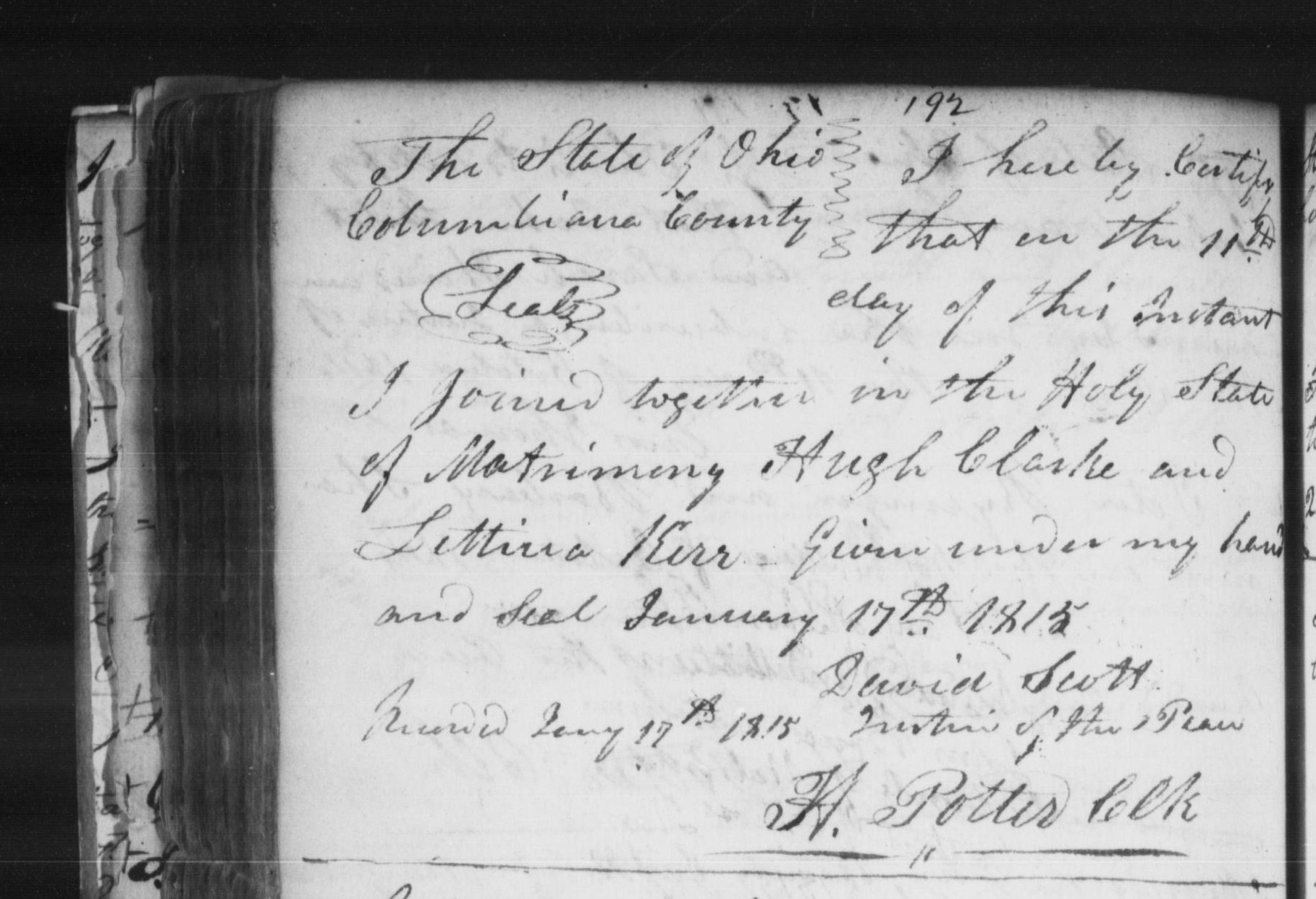
Marriage Certificate for Hugh Clark and Letitia Kerr.
On 11 January 1815, the widower, Hugh married Letitia Kerr in Columbiana County. Letitia was the daughter of James Kerr (also a teacher) and Hannah Beard. Hugh and Letitia had seven children together:
Violet, born 1816, m. Martin Saltsman
James, born 1818, m. Mary C. McMillen
Amelia, born 17 May 1822, (my 3rd gr-grandmother), m. John Paisley
Julia Ann, born 26 July 1824, m. Edward McCloskey
George D., born about 1829, m. Amy Gonzales
Letitia Jane, born about 1833, m. John Campbell
John Littleton, born about 1836, m. Harriet A. Derrick
Letitia passed away in May of 1855 and Hugh died 12 December 1857. He is buried at the cemetery in Monroeville.
Hugh Clark WillA bill of the property sold by James Clark, administrator of the estate of Hugh Clark, deceased, at public sale April 3rd, 1858.
Descendants of Samuel Clark: From Hart Family History: Silas Hart, HisAncestors and Descendents: William Lincoln Hart; Alliance, Ohio 1942
Mack, Horace. History of Columbiana County, Ohio: With Illustrations and Biographical Sketches of Some of Its Prominent Men and Pioneers. Evansville, IN: Unigraphic, 1976. Web.
History of the Upper Valley – Vol. I – Publ. Madison, Wis. – Brant & Fuller – 1891 – Page 306
Mary Catherine “Mayme” at left and sister, Florence Paisley, on right.
Name: Mary Catherine “Mayme” PAISLEY Birth: 22 March 1876; Salineville, Ohio Parents: Simon E. PAISLEY and Jane WYCKOFF Spouse: Lewis David McCONNAUGHY Death: 16 December 1957; Amsterdam, Jefferson, Ohio Relationship to Hollie: maternal 2nd great aunt
Name: George Ira PAISLEY Birth: 16 March 1882; Salineville, Columbiana County, Ohio Parents: George PAISLEY and Salome H. NEWELL Spouse: Myrtle B. GARDNER Death: 24 August 1940; Newton Falls, Trumbull County, Ohio Relationship to Hollie: maternal 1st cousin 4x removed
“The Flood.” New Harmony Register 14 Aug. 1875: 3. Web. 11 Mar. 2015.
THE FLOOD
1828 versus 1875
Destruction and Devastation
“Water, water everywhere! There are few of our citizens who do not know of the extent to which the classic Wabash has, in past years, risen, and but few who have not felt the effects of it in a greater or lesser degree; but such an occurrence as the present rise – the magnitude of which has never been witnessed by any one living – claims more than just a passing notice. January and June freshets used to be looked for in times past, as regularly as those months came round, but for such a rise as the present to pour down upon us in August, is unprecedented and will probably never again be witnessed. The well-remembered rise of 1828 is no longer a data, as the rise of August, 1875, which reached its highest point last Tuesday, saw it and went twelve inches better. The flood of 1828 can now step down and out, and those old citizens who boasted of having seen the Wabash at such height as has never been reached since, and probably never before, will have to keep in the shade and yield to their descendants the “glory” they have themselves so long enjoyed. At this writing, Wednesday evening, or town is surrounded with water…”
Thomas John Hackathorn and (probably) son, George. Photo courtesy of Merrianne Hackathorn.
Thomas John Hackathorn, my great-grandfather, was a boy of ten years old when his family was caught in the midst of this flood. You can read more about the family’s experience here in the week three posting of the 52 Ancestors Challenge. I am trying to imagine the destruction of the flood through the eyes of a boy and wonder if he was scared, or if he found it exciting, or perhaps a bit of both? It is a little difficult reconstructing Thomas’ life after the flood. We know that his father, Jacob, contracted smallpox and died within ten months of the flood. The oral history account of this time given by Thomas’ younger sibling, and only sister, Jennie, states that they were able to keep the family together after the flood, but what happened after the death of their father in June of 1876 is pretty much unknown.
As was mentioned in week three, Christian had remained in Kansas when the family started their journey back East after successive years of crop failures. James married the Ickes neighbor, Lyde in 1879. At the time of the 1880 census, we find James and Lyde living not too far from James’ mother, Mary, in Vigo County, Indiana. We also find Mary with two of her sons, Jacob and William. Silas is working as a farm hand and boarding there, also in Vigo County. But where are the three youngest children, including Thomas? Thomas, Crawford, and Elizabeth Jane (Jennie) are nowhere to be found. I have searched the 1880 census for years looking for some clue to where they might be. I looked for those children in the households of grandparents, aunts and uncles, and cousins in Indiana, Michigan, Pennsylvania, Iowa, West Virginia, and Ohio. I’ve undertaken what amounts to a door-to-door search in Vigo County, Indiana thinking that they might have been farmed out to neighbors. I’ve searched orphanages and asylums without finding a trace. I don’t know if, perhaps, they had been placed under some sort of guardianship after the death of their father or not because I have not found any documents or newspaper articles to that note. They just…disappeared.
This is not the first time that I’ve had problems finding this particular family. I have yet to find them in the 1870 census. After searching for many variants of the Hackathorn surname, including, but not limited to, Heckathorne, Hagglehorn, Hickenhorn, Hackleborn, Hakeltorn, and Headstrom (yes, indeed, Headstrom), I have convinced myself that the family was probably traveling in their covered wagon somewhere in Missouri or Kansas at the time of the census in 1870. What we have are about 30 years where we know almost nothing about where the family was living and what they were up to.
Thomas John Hackathorn was born on Sunday morning, 16 April 1865. It was Easter day and the nation was still in shock at the assassination of Abraham Lincoln. Just the week before, Lee had surrendered to Grant, the Civil War was winding down, and Jacob and Mary were itching to leave Ohio and try their fortune out West. In 1866 they began their westward trek with their older sons and year old Thomas in tow.
Children of Jacob and Mary Hackathorn – Thomas John second from left, back row.
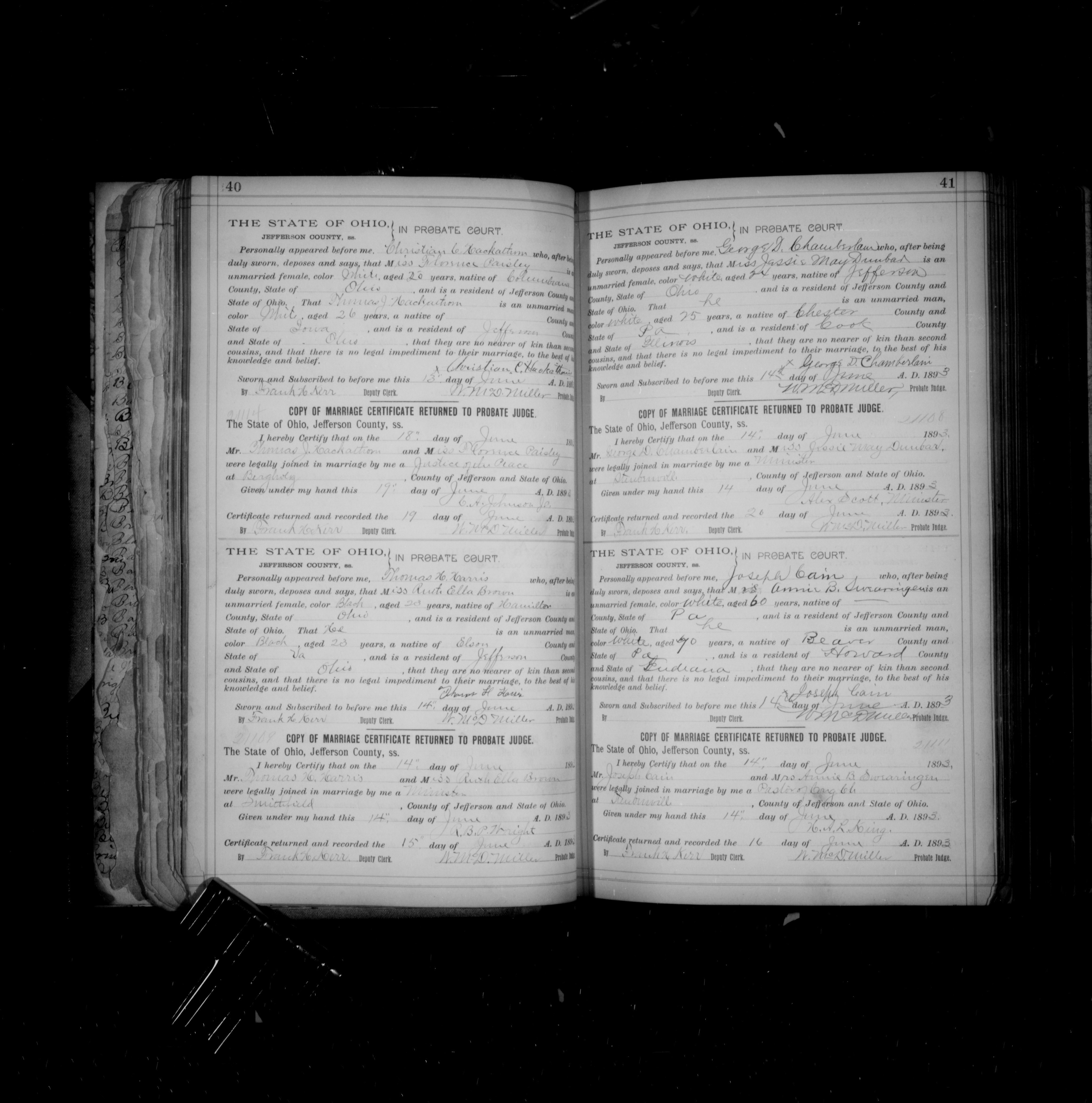
Until we can fill in the missing years after the flood in Indiana, we can pick up the siblings’ lives again when they have all reappeared back in Ohio – with the exception of James, who remained in Indiana. We know that, at least, William was back in Ohio when he married in 1884. Silas married in 1886. Widowed Christian was back in Ohio from Kansas and married in July of 1893. Jennie married in 1893 also, followed by Crawford in 1895, and Jacob in 1898. Thomas’ mother, Mary, passed away in Bergholz in December of 1896. Thomas John married Florence D. Paisley on 18 June 1893 in Jefferson County, Ohio.
Florence Paisley and Thomas John Hackathorn
Thomas and “Flora” were married just weeks shy of 24 years when Florence died in childbirth with her 15th child, who was born premature. Of their children, only nine survived to adulthood. After his wife’s death, their oldest daughter, Mary, 23 and a teacher, assumed the role of caring for the eight younger children. His entire adult life, Thomas had been a coal miner and, apparently, a moonshiner and bootlegger. Perhaps the rest of the family knew this fact, but I did not until a few years before my grandmother died. One Saturday we were at Grandma’s apartment because my son had to interview someone for a project at school. He chose his great-grandmother. I was sitting on a footstool glancing at a book and listening with half an ear (because I had already heard a lot of the stories) when my son asked what her father did and she revealed this little tidbit. Surprised is not the word for my reaction. I jumped up and said “Grandma, why haven’t you ever told us this before?” And she replied that it wasn’t something that you usually mention in polite company and how did we think that her father fed nine kids? Not from the coal mines…
“Several Plead Guilty Before Federal Judge.” Elyria Chronicle Telegram 13 June 1939: 1. Web. 11 Mar. 2015.
It appears from talking with various cousins that the production of whiskey was something of a family affair and that there was most certainly a connection to the Whiskey Rebellion in Western, Pennsylvania. (But, that…is another story.)
Thomas Hackathorn and sons; George, on left, and Jack on right. Photo courtesy of Merrianne Hackathorn.
Thomas died 25 April 1949 of a cerebral hemorrhage at 84 years of age. He is buried in the Bergholz Cemetery.










 RELATIVITY
